Artist Halil Altindere has created another support-focused art project with Ahmet H. Uysal, a Trustee and Board Member of the Educational Volunteers Foundation of Türkiye (TEGV), whom he met by chance a few years ago in Inonu Park while taking his son out, and with whom he has since developed joint projects. In this new project, runner Uysal’s special marathon route within Istanbul forms the expression “TEGV30” from above as part of a GPS Art concept. While explaining the project – which will be introduced and put on sale for charity at Pera Museum on the evening of December 10 – Altindere and Uysal emphasize the contribution the artwork will bring to children and to the future.
One of the leading names in contemporary Turkish art, Halil Altindere has once more turned Istanbul’s streets into an artistic track through “Istanbul: Art of Running / Kosmanin Sanati” a project created with Ahmet H. Uysal – Trustee and Board Member of TEGV – in honor of the foundation’s 30th anniversary.
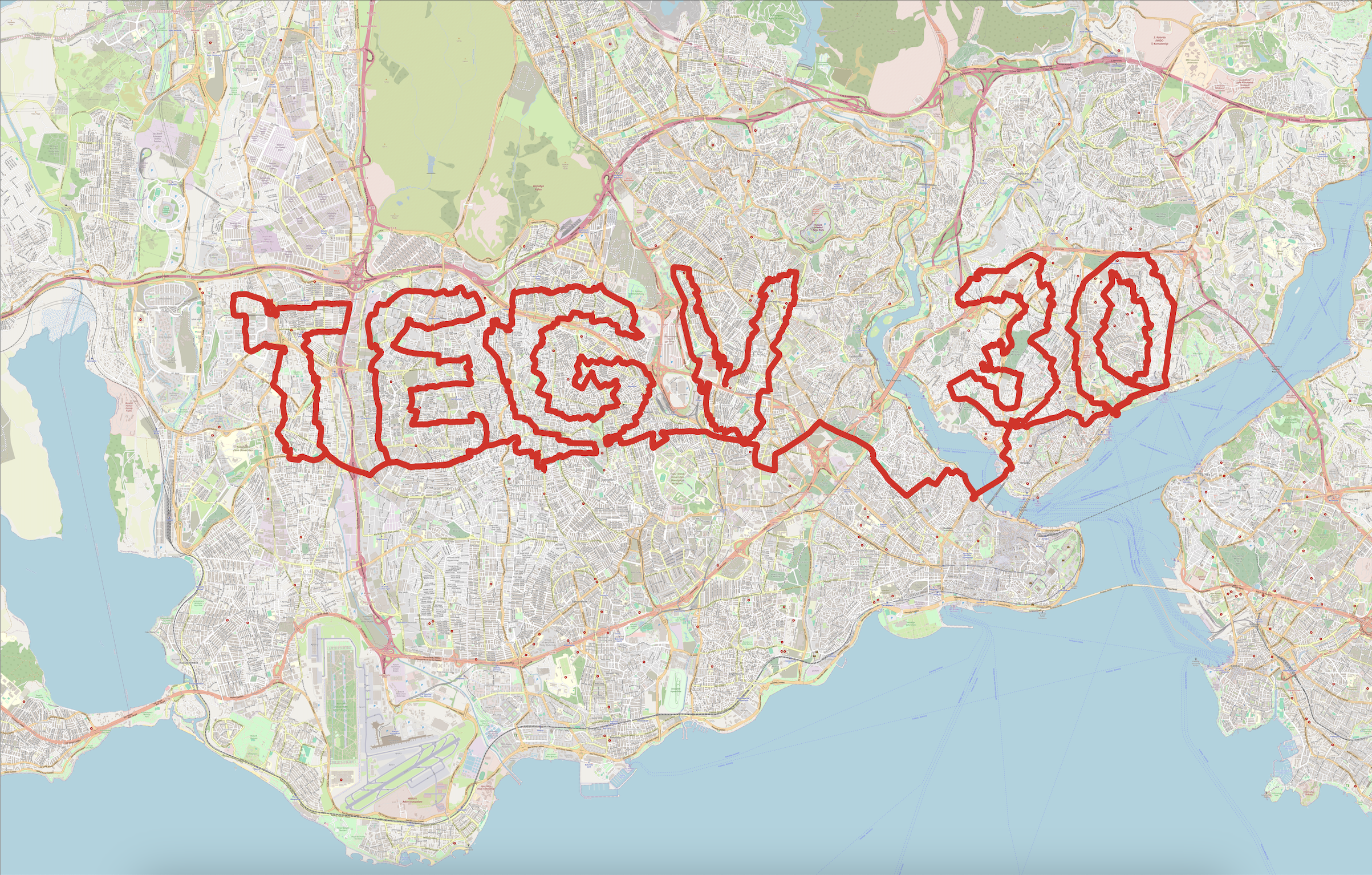
On Wednesday evening, December 10th, the project – set to be presented in detail to the press and the public at the Suna and Inan Kirac Foundation Pera Museum in Tepebasi – features Uysal running a challenging route that stretches from Kucukcekmece all the way to Besiktas, passing through various districts of Istanbul. Using GPS technology, this specially designed route ultimately forms the inscription “TEGV 30” on the city map.
Altindere’s related work transforms this run into an artistic expression while also serving a social purpose. The piece aims to provide a creative contribution to TEGV’s 30-year educational journey carried out on behalf of children.
But before that, with your permission, we have one more creative story to tell.
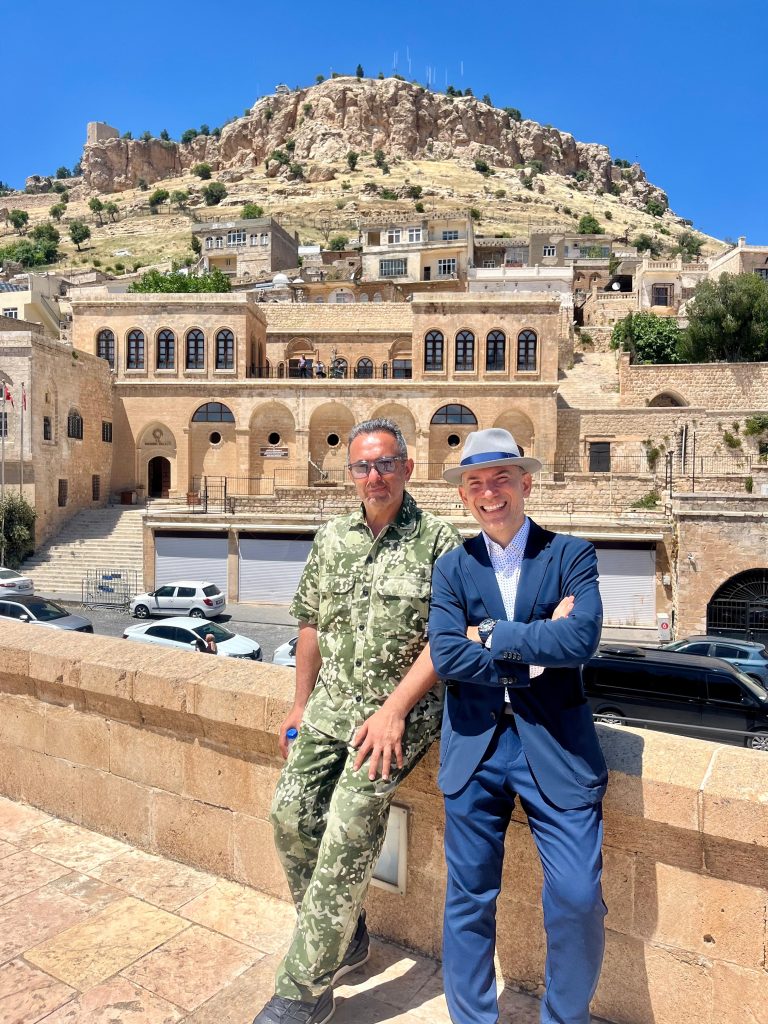
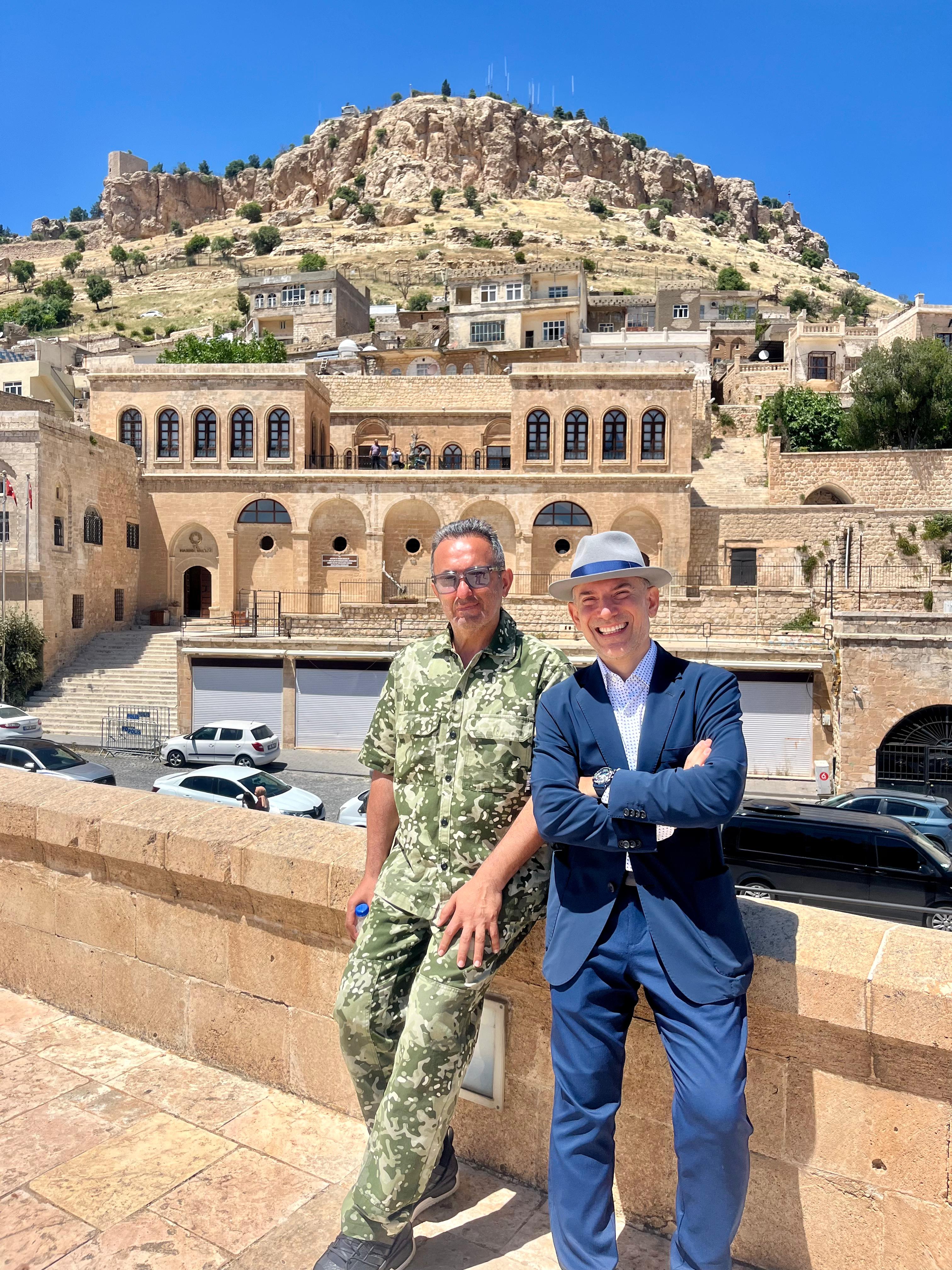
In fact, the collaboration between Altindere and Uysal is not their first of its kind. The seeds of their friendship were planted a few years ago while their six-year-old children were playing in Inonu Park, where the duo had previously undertaken another project.
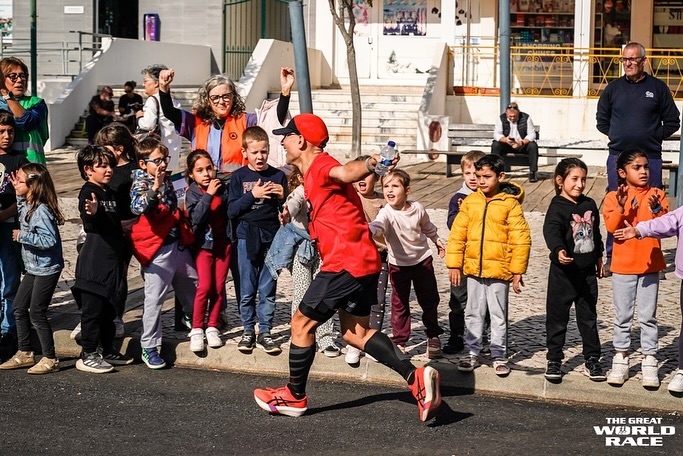
Altindere notes that he met Uysal while the latter was training alone with his son, and one day he learned that Uysal would be running “seven marathons on seven continents in seven days.”
Explaining how closely he followed the subject, the artist noted that while describing the details of Uysal running in every climate; after completing a marathon on one continent, the team would fly to another continent using a cargo plane they had chartered, resting during the flight and thus completing the entire route.
Stating that he found this intriguing work by Ahmet H. Uysal and his friends “quite childlike,” influenced by the friendship their children had developed with one another, the artist Altindere created his first artwork on this very subject during those days.
Artist Altindere, who also created a “3D scans” of Uysal, tells us that he designed a digital video film based on this 3D character. Stating that this process evolved into an augmented reality animation video titled “The Man Running for The World,” and that the work was also designed as an NFT, Altindere adds that they subsequently produced a children’s book under the TEGV label.
The artist notes that the book, whose story is written by editor, author, poet, and critic Sureyya Evren, includes pages depicting Uysal running in every season and on every continent. He also points out that, through the augmented reality (AR) feature in the same book, young readers will be able to see Uysal in motion-running.
Altindere adds that, beyond this, he also created a film referencing the book, produced in five original copies, which were sold and donated to TEGV. Growing up in Mersin himself, Altindere emphasizes that he and Uysal – who spent his early childhood in Adana – donated all proceeds from this project to TEGV schools in the region.
Speaking about his piece “Istanbul Map: Art of Running,” Altindere shares the following with us:
“As you know, today there is a concept called “GPS Art.” We can also describe it as map-based running. People usually run across city maps, leaving small messages or symbols on the streets. Ahmet also continuously records his runs with his wristwatch. Using software, we looked at the map of Istanbul from above and wanted to create the phrase “TEGV 30” in a way that Ahmet could run along the streets and avenues.
By looking at Istanbul through satellite and Google, we selected the most suitable neighborhoods. While doing this, we made sure that Uysal would run one marathon per day and form one letter. He ran TEGV 30 in six days, covering 133 km from Kucukcekmece to Besiktas to draw it. For this project, we also produced a Fine Art Print series and placed the phrase “Istanbul: Art of Running” on it. We also wanted to add an animation video alongside it.
In this project, it is also the case that both the pushing of the limits of the body, the fact that the project serves a certain benefit, and the experience of a text that is visible to the artist being re-experienced by him, bring together elements related to different art forms. We will again produce 30 editions and allocate them for children’s education. It is beautiful collaboration like this.”
When we asked Altindere whether art itself is also a marathon, he told us, “I’ve already been running for 25 years.” When we then asked what kind of trace he leaves with his art, who examines these traces, and how he practices his contemporary art training, he responded as follows:
“Running a marathon is about staying constantly in shape; otherwise, it’s not easy to run a marathon for 25 years and not fall of the course.
As you know, I create works that are nourished by everyday life. And Ahmet is someone I met in the park. When I met him while our children were playing, Ahmet wasn’t expecting anything like this. You know, such friendships between fathers in parks usually lasts only until they take their kids home. But with Ahmet, it turned into an actual friendship. He wasn’t expecting us to propose so many projects to him – films, books, art projects. First a video, then a book, and now this: a performative piece dedicated to TEGV’s 30th anniversary.”
On New Year’s Eve, preparing projects for two different biennials for 2026, Altindere offers the following comments about Ahmet’s run:
“Marathons are usually run on straight courses; however, while Ahmet was running in Kucukcekmece, he would find that a wall had been built across the path. Or someone had put up a shack, or on the other side a cemetery appeared before him, or a dog chased him!
Therefore, Ahmet told us that for each marathon he essentially put in the effort of four marathons. Think about it: the GPS in a taxi tells you “Go this way, not that way,” yet Ahmet keeps running but there is nothing there! The irregular urbanization of Istanbul often misled him while running. For example, he had to take an overpass or he chose a pedestrian crossing so as not to disrupt the TEGV 30 layout.
Ahmet tells us that while running from Kucukcekmece to Besiktas over six days, he experienced a journey in which he observed the city’s many different layers. He encountered people from various economic and social backgrounds across different neighborhoods.”
Artist Altindere, on the other hand, shares with us the following noteworthy remarks during our conversation and in connection with the TEGV 30 initiative:
“In the kinds of projects, we carry out with Ahmet, the work meets a significant audience during its production, but afterward it also impacts the lives of small children we don’t even know, in different environments and cities; and this is immensely gratifying! The fact that it is not merely a piece hung in a collector’s home, but one that supports the education of many children in many cities, leads one to view the situation from a very different perspective.”
Responding to our questions on the subject, Ahmet H. Uysal – Trustee and Board Member of the Educational Volunteers Foundation of Türkiye (TEGV) – shares his thoughts on the matter of collecting as follows:
“We have a few artworks at home that I love very much, but of course nothing at the level of a collector. (My collection is really the dozen of marathon medals I’ve accumulated over the years.) Our most valuable piece is Mr. Altindere’s work titled Carpet Land.
In 2018, during another run for TEGV, I ran alone from Artvin to Fethiye – 1650 kilometers in 46 days. Crossing mountains, hills, plains and valleys, I spent hours running some days on highways and other days on village roads.
Whenever I look at Mr. Altindere’s artwork Carpet Land, I am reminded of those incredible kilometers that often felt like a dream; and the piece carries me into a fantastical state of thought were dreams and reality blend together.”
Ahmet H. Uysal, while on the subject, also answered our question about how TEGV brings future generations together with contemporary art as follows:
“TEGV knows that art holds an indispensable place in children’s education. For this reason, one of its six main activity areas is art.
And since 2003, an art activity called “Dreams Workshop” has been offered.
“Dreams Workshop” is an educational program that aims to develop the life skills of children and volunteers through plastic arts in specially designed art studios. “Dreams Workshop” creates environments where the child is recognized as an individual with their differences, can express themselves, freely reveal their creativity, and think in a design-oriented way.”
Uysal lastly outlines for us the objectives of TEGV’s “Dream Workshop” program as follows:
- To support life skills such as creativity, collaboration, communication, and self-confidence through Plastic Arts.
- To support children in experimenting with artistic ideas and discovering them through observation, curiosity, research, imagination, and emotions, and in creating artistic works that express these ideas.
- To create habitats and promote sustainable living by using materials such as clay and applying various three-dimensional techniques and methods.
- Conducting group activities based on getting to know artists like Matisse, raising awareness about the effects of the climate and water crisis, and building strong networks to address climate issues.
- Supporting children in experimenting with artistic ideas and discovering them through observation, curiosity, research, imagination, and emotions, and in creating artistic works that express these ideas.
- Drawing inspiration from versatile artists and using all materials – including recycled ones – to develop design skills.
For information: tegv.org / https://halilaltindere.com/