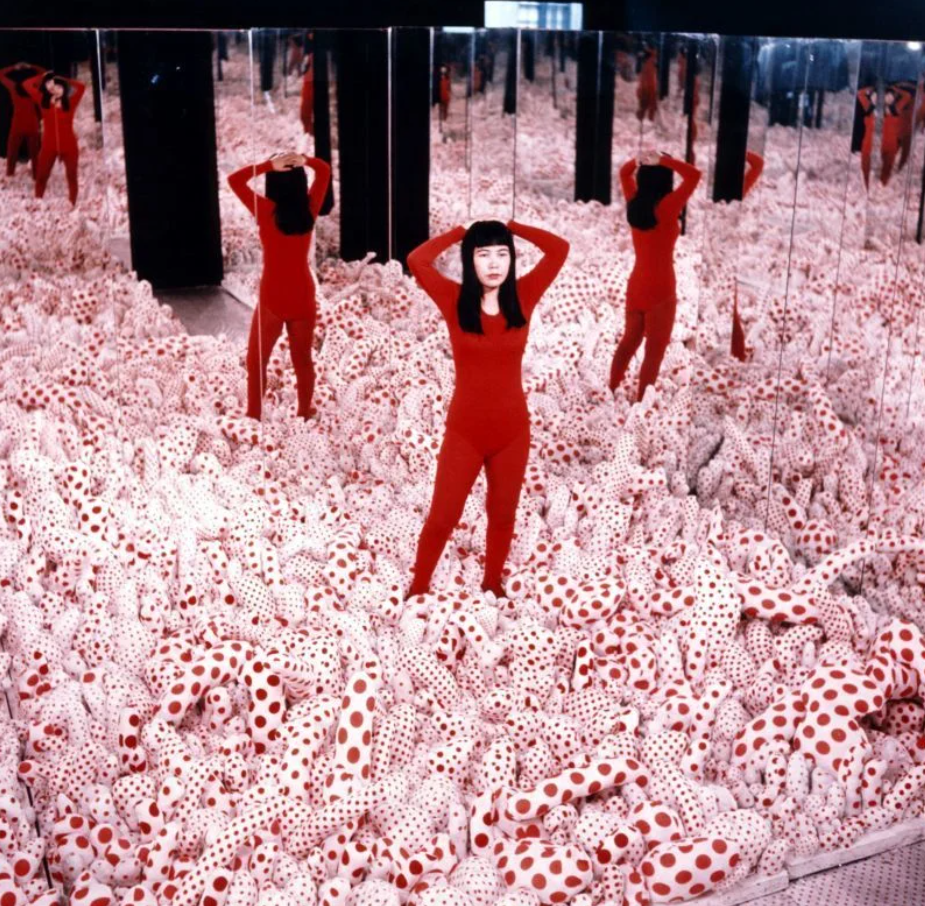
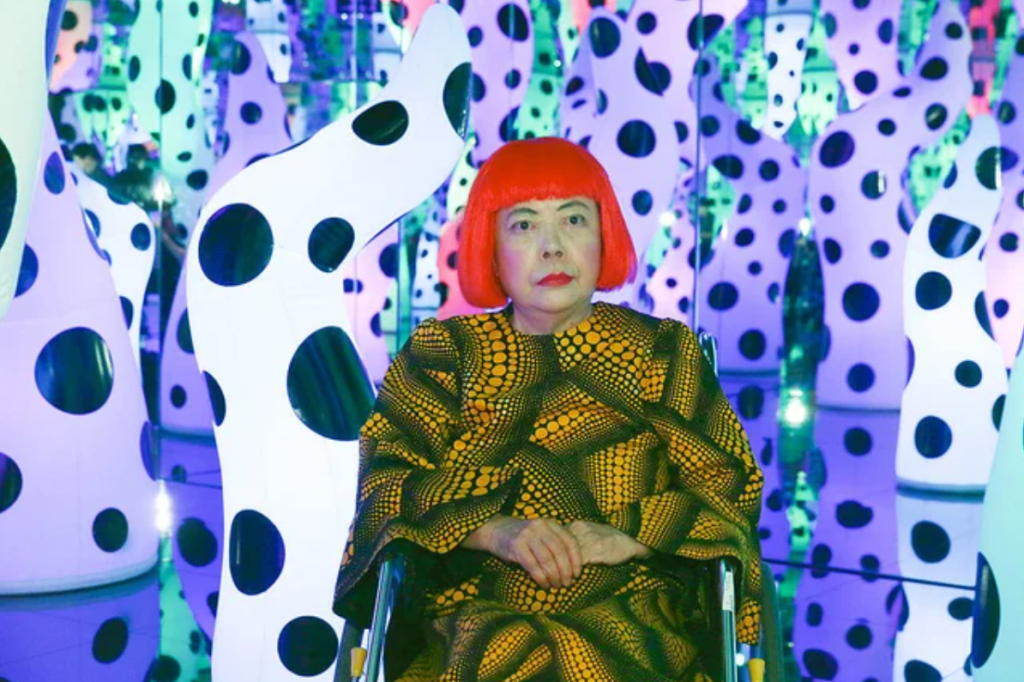
Imagine a woman who, at the age of 44, voluntarily admits herself to a psychiatric hospital. Admired around the world, this woman sees the world in polka dots. Yayoi Kusama, one of the most important artists to emerge from Japan, works during the day in her three-story studio and sleeps at a clinic at night. This is the extraordinary personality and story of the “Queen of Polka Dots,” who passed away at the age of 97 on August 14, 2026.

The Artist Who Voluntarily Admitted Herself to a Psychiatric Hospital / Demet Cengiz
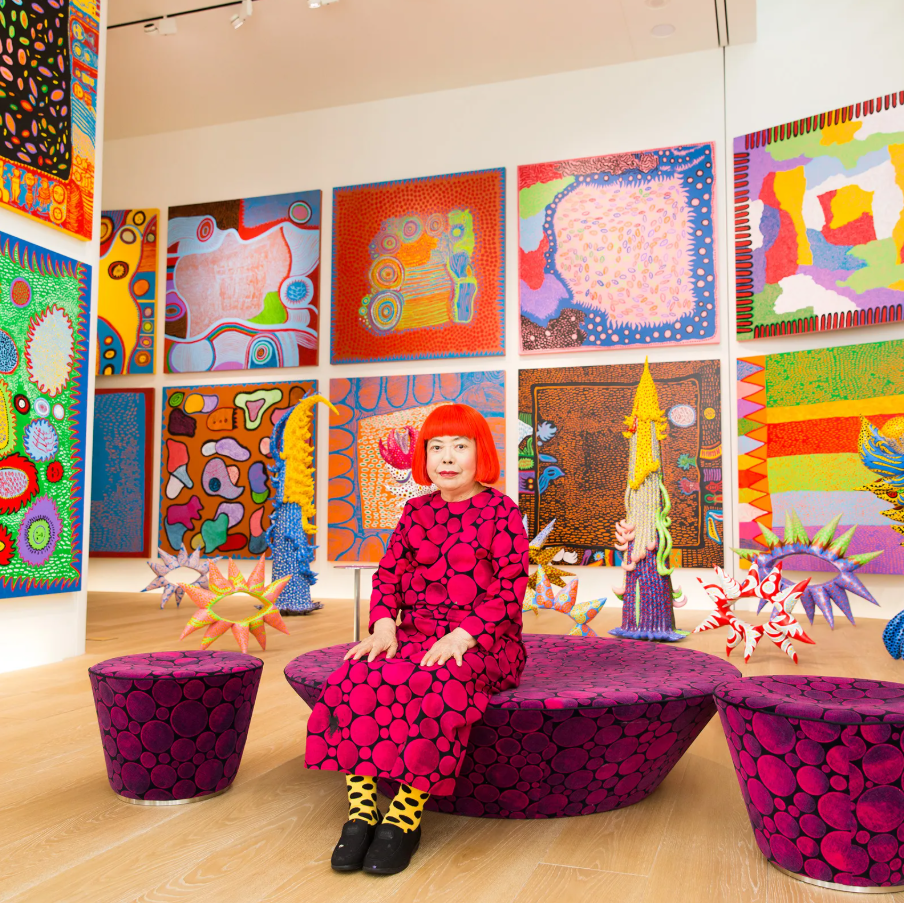

Yayoi Kusama was born in Japan on March 22, 1929. I had the opportunity to visit her birthplace, Matsumoto in Nagano, twice. Located in a mountainous region of Japan at the confluence of two rivers, it is famous for its hot springs and winter sports.
Yayoi was born as the fourth child of a wealthy family; she had two older brothers and an older sister. Her merchant family ran a nursery and seed farm. Her father was known for his womanizing and was always looking for affairs outside the marriage. Perhaps the greatest wound of her childhood was the emotional abuse her father inflicted on her mother. As a result, at a very young age, she became her mother’s spy. She would secretly follow her father when he left the house and watch his affairs. This task of spying deeply affected both her young body and her mind, which was not yet able to fully comprehend the world. She developed a lifelong aversion to sexuality and began to see the world through polka dots.
Traumatic Childhood
While still in elementary school, she began obsessively drawing pumpkins. From the age of 10, she began seeing polka dots on every person, every object, and every living being in the world. Even the most stationary objects seemed to speak to her in a fluid way. Yayoi kept drawing this moving world she saw, again and again. Of course, in their home, where strict rules prevailed, there was no room for either art or dreams. Her mother hated her painting and, if she caught her drawing, she would scold her and throw away her sketchbooks and paints. She would also frequently beat her. Just as she secretly followed her father, for a while she also made her drawings without anyone seeing them. But she drew with such obsession that it was impossible not to get caught.
Her traumatic childhood and hallucinations formed the foundation of her artistic style. In an interview, she explained the origin of her obsession with pumpkins. As a child, she had gone to a harvest with her grandfather, where she was deeply impressed by a pumpkin she saw. She found these large vegetables, which inspired admiration in no one else, fascinating, pleasing in form, and generous. Despite their enormous form, these vegetables had a modest nature.
Her adolescence coincided with World War II, and she was assigned to make parachutes in a factory. She remembered that period as dark days filled with the frightening sounds of American bombers and air-raid sirens.
From A Vanishing Self To Art
She had also said that the smooth white stones covering the riverbed she saw every day as a child may have been the source of her fascination with polka dots.
She described her vivid hallucinations as flashes of light, halos, and dense clusters of dots. Sometimes flowers spoke to her. At other times, fabric patterns suddenly came alive, multiplying until they swallowed or erased her. Her sense of self disappeared. She carried these experiences, which she called “self-obliteration,” into her artistic career. She had found art as the only way to escape both her family and her own mind. Supposedly, she was escaping her own mind, yet throughout her life she continued to depict the tricks her mind played on her. She always embraced her art by saying, “It is my medicine.”
Pop, Hippie, Avant-Garde
Despite all her family’s objections, Yayoi Kusama studied Nihonga (a Japanese style of painting) at Kyoto City University of Arts for a year. However, she quickly grew tired of this traditional form of Japanese art. She began to take an interest in European and American art. She held her first exhibitions in Japan.
One of her biggest conflicts with her mother occurred when, at the age of 28, she still had not married as her older sister had. Just as she confronted the vegetables that seemed to obliterate her, she decided to move to the United States—the country that had dropped the atomic bomb on Japan. She settled in New York in 1958, drawing inspiration from American Abstract Expressionism. During the 1960s, she became part of both the Pop Art movement and New York’s avant-garde art scene. She embraced the rebellious spirit of hippie culture and drew public attention through numerous “happenings” (spontaneous performances), in which nude participants were painted with brightly colored polka dots. Their nude bodies symbolized peace and love in opposition to war. Her work influenced contemporaries including Andy Warhol and Claes Oldenburg.
She became an artist best known for her sculptures and installations, while also working across painting, performance art, video art, fashion, poetry, fiction, and other artistic disciplines. Rooted in conceptual art, her work incorporated elements of feminism, minimalism, surrealism, art brut (raw art), Pop Art, and Abstract Expressionism. She also infused her work with autobiographical, psychological, and sexual themes. While she felt an aversion to sexuality, she also explored the subject in extreme ways. She went on to become a global phenomenon.
‘Obliteration Room’
One of Yayoi Kusama’s most widely acclaimed projects was “The Obliteration Room.” She invited visitors into a room painted entirely white, along with all the objects inside it, and asked them to place polka dots of various sizes and colors wherever they chose.
In 1973, she returned to her country and voluntarily admitted herself to a psychiatric hospital. She began a literary career, writing novels, poetry, and autobiographical books. She spent hours working in her studio during the day and went to the clinic at night to sleep.
After a quieter period in the 1980s, Kusama regained international recognition in the 1990s. She became a highly sought-after artist at leading museums, biennials, and exhibitions around the world. She collaborated with Louis Vuitton on a special project and appeared on the covers of fashion magazines.
A Museum Named After An Object Of Shame
She received numerous awards, including the Asahi Prize, presented by the Asahi Shimbun newspaper in 2001; the French Ordre des Arts et des Lettres in 2003; and the Japan Art Association’s 18th Praemium Imperiale in 2006.
Having become a source of embarrassment in Japan due to the radical nature of her work in the 1960s, and having had her name removed from the schools she attended, Yayoi Kusama was honored in 2017 with the opening of a museum bearing her name in Tokyo.
In a 2012 interview, Yayoi Kusama said:
“Every day, I struggle with pain, anxiety, and fear; the only way I have found to alleviate my illness is to continue creating art. I followed the path of art and somehow discovered a way that would allow me to live.”
She was given various diagnoses, including obsessive-compulsive disorder (OCD), schizophrenia, and bipolar disorder with psychotic symptoms, but she paid little attention either to the harshness of life or to the diagnoses she received.
She was among the world’s best-selling female artists and ranked 19th on Sotheby’s list of the top 50 artists in 2023. She was aware of these figures and accolades in the outside world, but in her inner world, none of them mattered. Her inner world was filled with polka dots and pumpkins.