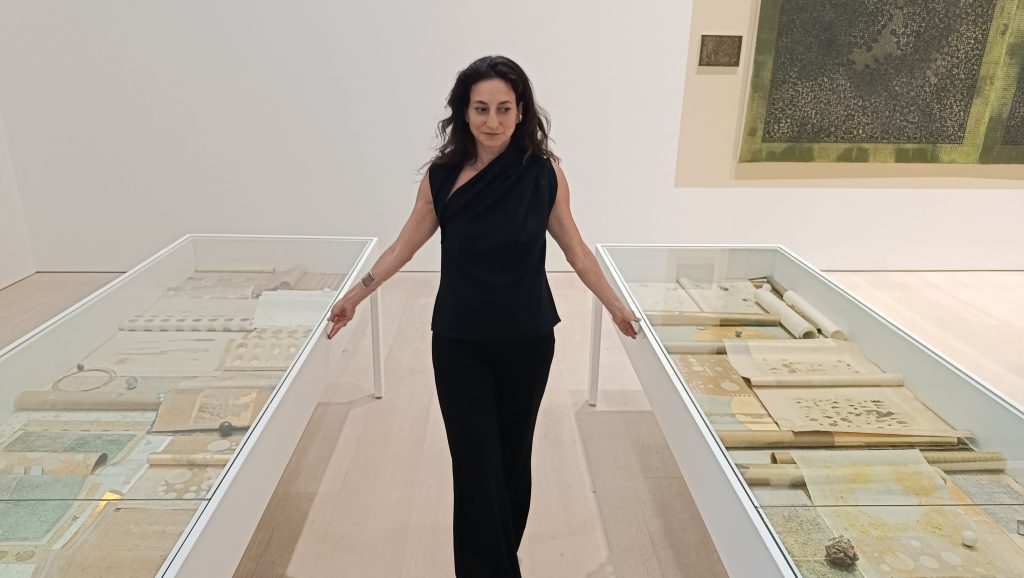
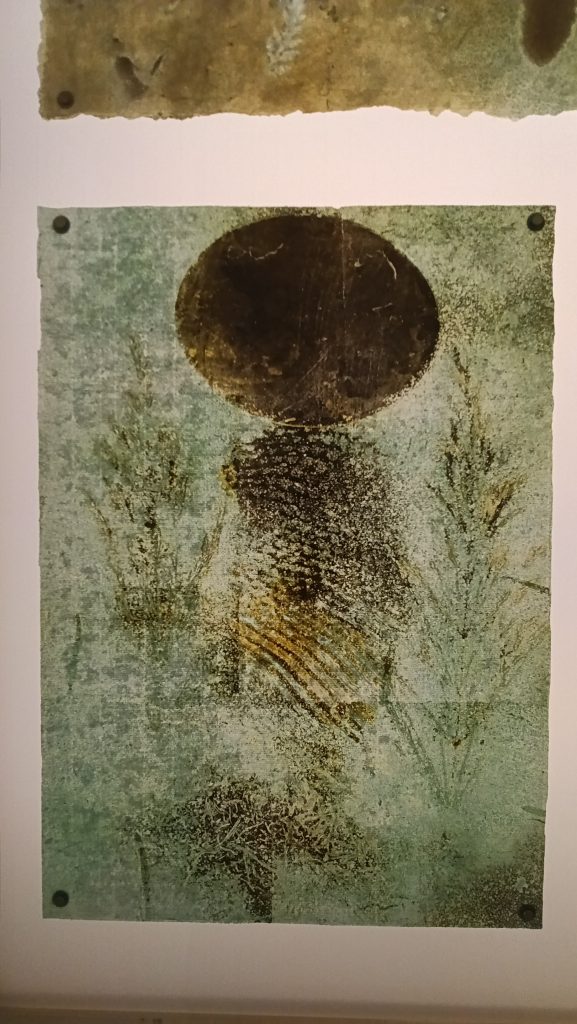
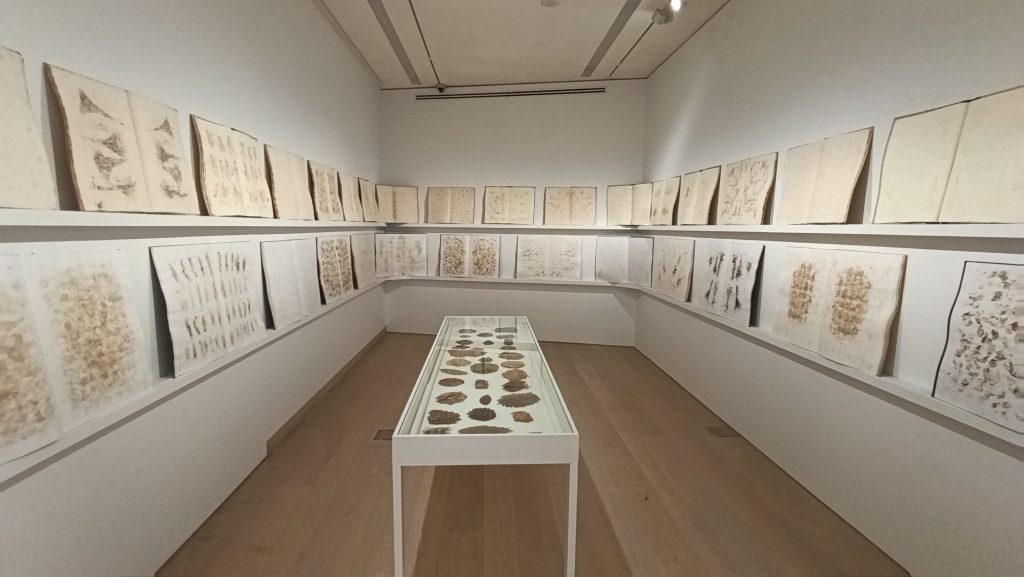
Tayfun Erdoğmuş’s exhibition Atlas 1/137,035999 at Arter, curated by Eda Berkmen, resembles a vast passage that runs through forms, silences, and the spaces between light and darkness. We met with curator Eda Berkmen and artist Tayfun Erdoğmuş to discuss the exhibition, which invites viewers to become active participants. For Erdoğmuş, the exhibition is a self-growing structure—a kind of architecture. For Berkmen, it is an event that inscribes what cannot be contained by language into time, space, and the human experience.

The Potential Blossoms and Shells of Light and Darkness / Evrim Altuğ
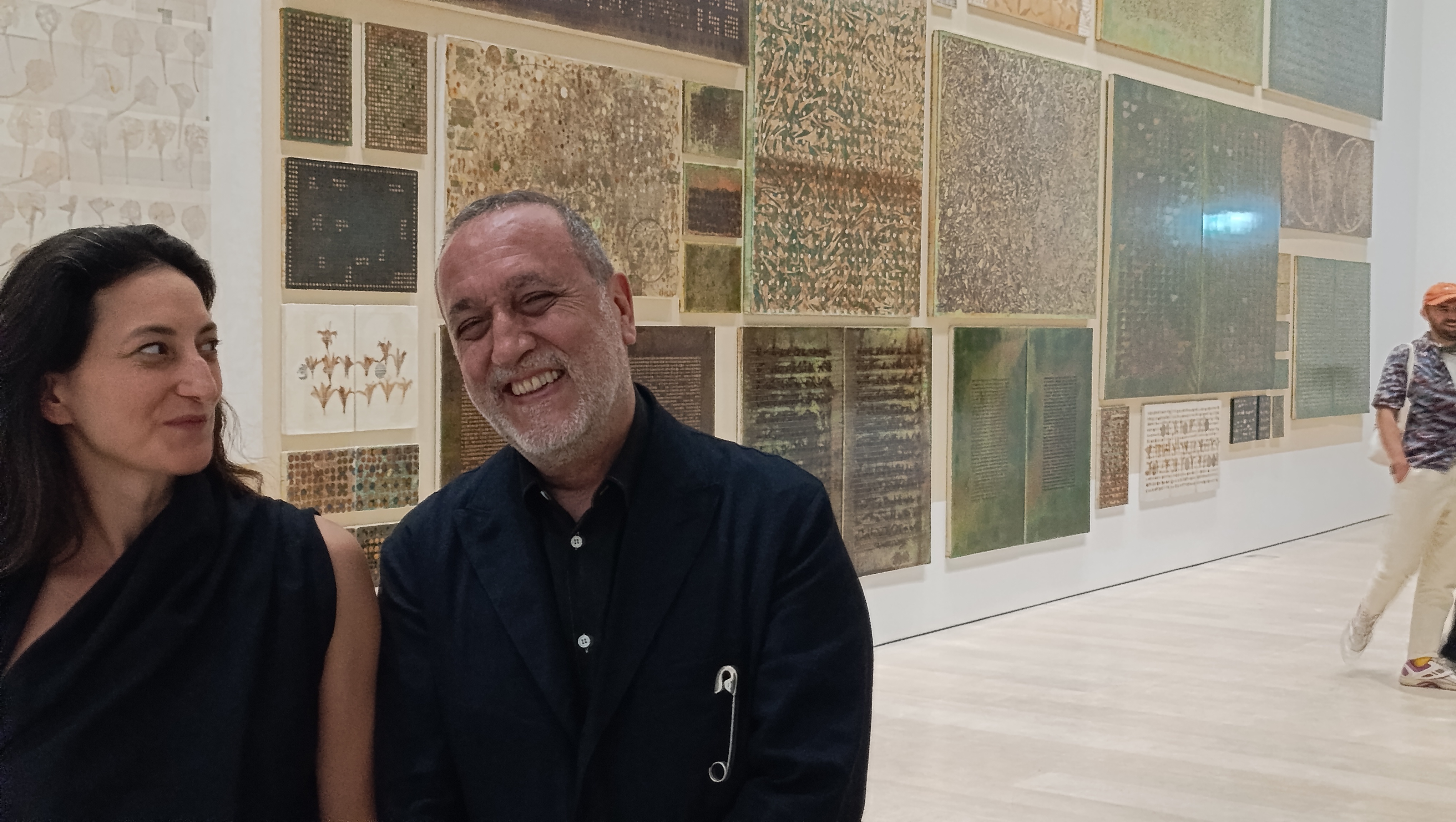
Artist Tayfun Erdoğmuş’s first institutional solo exhibition in Türkiye, Atlas 1/137,035999, invites viewers to contemplate the structure of matter and the universe, the relational patterns that shape life, and humanity’s ongoing effort to perceive, interpret, and shape existence through both atomic and cosmic scales.
The exhibition, curated by Eda Berkmen, also offers an opportunity to trace the visual and conceptual layers that have shaped Erdoğmuş’s practice, situated at the intersection of traditional, decorative, and fine arts. A Gallery Nev Istanbul artist, Erdoğmuş continues his life and artistic work primarily in Germany.
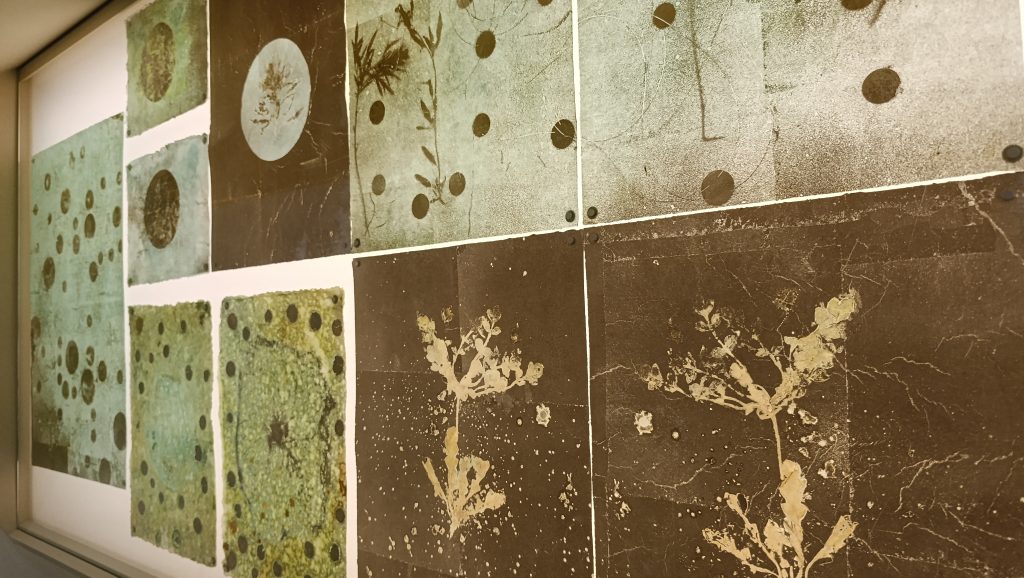
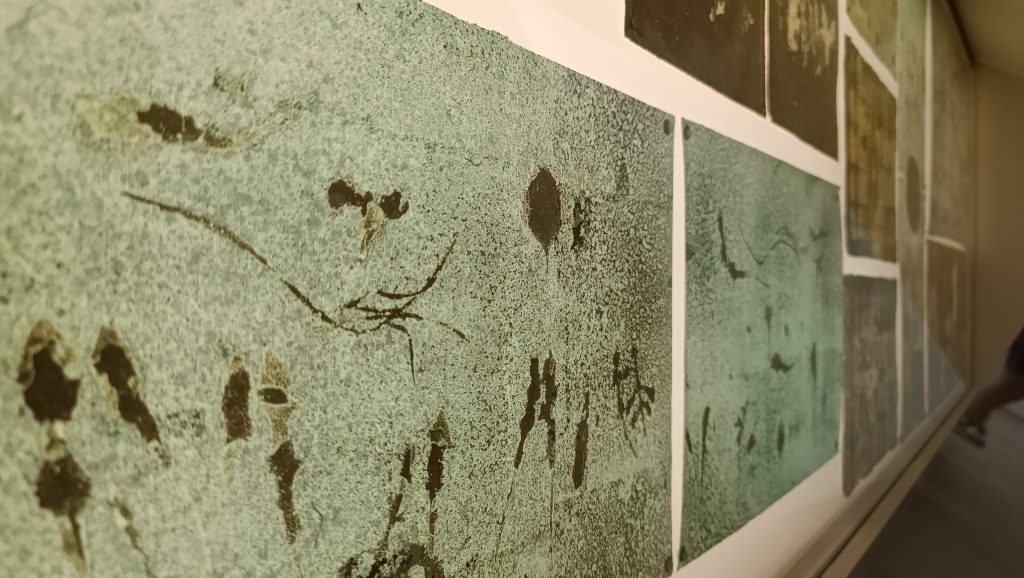
Working with plants, minerals, handmade papers, and chemical and acrylic solutions, Erdoğmuş approaches his practice much like a natural scientist or an alchemist. According to Berkmen, the exhibition’s title, Atlas 1/137.035999, can also be read as a coordinate assigned to this geography.
As I move through the exhibition, my thoughts increasingly dwell on the existence and function of the alphabet. By “alphabet,” I mean sequences, orders, and the scales of value attached to words unfolding one after another.
After all, this is how words exist for us. Yet it seems to me that what Tayfun is attempting is to circle around the alphabet itself, allowing us to sense the existence of something akin to a “Beta-script” or a “Gamma-script.”
Through multiple layers, Erdoğmuş concentrates on the act of signifying “things,” states of being, and moments in time in multiple ways. His practice is, at once, a form of archiving and counter-archiving. It proposes an understanding of the archive that does not even seek a relationship with its own authority—a counteractive practice that unsettles the very notion of power.
Under these conditions, the artist prepares us for a profoundly multilayered experience and leaves us witness to a great explosion. Then, in another sense, the exhibition comes to an end like a black hole. And yet, from there, it begins to generate itself anew.
In Erdoğmuş’s work, the eye challenges language itself. It pushes the limits of reading, understanding, self-awareness, and the formation of subjectivity through the object. Looking at his work, one realizes that he is as much a craftsman as he is an unmistakably conceptual artist. Through his gaze, Erdoğmuş seeks to understand the human being while simultaneously searching for the nature within humanity, emerging almost as a Sufi artist. At the heart of this lies a profound question of alienation, one that he persistently engages with. He explores the alienation between art and humanity, between nature and humanity, and between the world and humanity, creating a powerful resonance among these ideas. It is precisely here that a profound and generative tension emerges.
With this in mind, we met with Erdoğmuş and Erkmen at Arter and recorded their reflections on this fertile tension, which will remain on view in Space for Art until January.
Let’s roll the dice: What unfolded between the rationality and irrationality of the exhibition (that is, between curator Eda Berkmen and artist Tayfun Erdoğmuş)?
Eda Berkmen: Let me start by addressing the idea of rationality and irrationality. When I begin working with artists, I always try first to understand what they are actually doing. I try not to impose a narrative.
From the outset, Tayfun was curious about what kinds of projects might be possible at Arter. Naturally, once you begin thinking about how such projects might take shape, certain ideas can quickly emerge in your mind. With this project, however, things were not quite so straightforward.
For me, it became almost frightening not to be able to control things beyond a certain point, not to be able to stand in front of each work and see it individually. Not being able to see the artwork that would ultimately be exhibited. Perhaps not being able to witness the process of its making. Because there is also a highly mysterious aspect to it. In any case, many of the works were in collectors’ hands. We were dealing with works on a large scale.
In a way, it was necessary to trust that process. And that, too, is somewhat irrational: for me, it involved surrendering to things you do not fully know or see, but that you collectively believe will come into being, things that emerge through conversations and subtle intuitions, trusting that they will ultimately work.
If there was any order or rationality that I tried to impose here, it was in preparing the viewer before they entered the exhibition’s grand, shocking, and deeply affecting dimension.
Tayfun is someone who can already perceive these surfaces. He can anticipate and sense materials such as wood, for example, then build upon them gradually, allowing them to gain strength and eventually open into something larger. What emerged in this process was, in part, the introduction of elements such as hierarchy, narrative, and chronology, all of which are normally absent from his practice, through the exhibition’s introductory section. At the same time, we were careful to keep these elements within certain limits.
What do you think, Tayfun?
Erdoğmuş: Yes, Eda captured it well. The exhibition’s introduction was not part of the original plan. To be honest, I was reluctant at first. But Eda insisted, and her instinct proved to be exactly right. She was particularly interested in including Defterler, the series we produced with Lokta paper in 1998. I now realize that it was the right decision. Those works almost function as a preparation for these layered paintings. They also belong to a period before I began working with plants.
That was a transitional period in my life. Bringing into the exhibition the memories that remained with me from everything I had lived through until then meant reconstructing the memory of what had been important to me. In doing so, different times began to overlap. It was not a linear progression. Many layers became intertwined. The knowledge I had gathered, the things I had learned, and my experiences all merged together, and from that, memory gradually emerged.
I’m glad those works became visible because the foundation of my painting practice has always been about creating memory and embedding that memory within the material like a fossil. That is why they also contained clues to the technique itself.
Another important aspect is this: I am, fundamentally, someone who thinks through making. I do not begin by planning things out and then setting off; rather, I learn from the things I make while I am making them. Sometimes they even resist me. In that sense, the technique I employ is a kind of alchemy. You may have command over certain aspects of a material, but at some point the material begins to impose itself on you and realize its own potential. Your role then is to recognize that process, make space for it, and do whatever is necessary to allow it to become what it wants to be. But everything, from the weather conditions to the material’s own inherent potential, points you toward certain possibilities.
In a way, this is very much like nature itself. Like nature, it unfolds according to its own logic. So I begin with my emotions, but the process also suggests reason. It allows me to feel life itself. And by learning from it, you find a way of carrying it forward.
Berkmen: I believe the exhibition explores both the boundaries of reason and rationality and the boundaries of perception. We can see—but only so far. We cannot see molecular structures themselves; we see only one form of their representation. And what we perceive often becomes something else in the act of looking. These elements are all connected, yet they cannot be fully contained in language. That is precisely what the exhibition evokes.
The exhibition is not “encyclopedic”. Instead, it places us in what feels like an aquarium, leaving us to figure out how to swim on our own. At its core, it is also an experiment in trust. What would you say?
Erdoğmuş: Of course, it would be rather bold for me to put it this way myself, but at the very least, what I try to do is avoid imposing any idea or mode of thinking. Instead, I try to create a space. This is the framework along which I proceed, but it is also the path the work itself travels in the process of coming into being. Therefore, when people engage with it, I want them to find their own journey. In fact, there is a route, a trajectory, even a kind of orientation. But within that route, there is also room to observe, to look from a distance, to feel, to experience oneself, and to accumulate impressions.
In a sense, that is what we hoped for: that each visitor would construct their own experience and create their own meaning. That they would read the work through the act of viewing. Because this is part of our tradition. We are people who derive meaning from what we see. We are people who deepen that meaning in our own way. The cultures that have emerged from this geography are, to some extent, built upon precisely this approach. We interpret what we see according to our own perspectives. We rarely insist, “this is exactly what it is”; instead, we suggest, we allude. And so, what I have done here is place those allusions before the viewer as a set of possibilities. The viewer, in turn, tries to perceive and interpret them in their own way. Naturally, there is an atmosphere that I have tried to draw and construct, but it is not an atmosphere that dictates.
Do the components of this Atlas have genders? Is that something that can be discussed? For example, we often say “Mother Nature,” or “mankind.” In that sense, is this not the exhibition of a woman or a man, but rather of the human being?
Berkmen: I absolutely do not think so. In fact, what you referred to as “alienation” is precisely what I found so intriguing. I have often said that the works maintain a certain distance. In a way, the exhibition also distances itself somewhat from the human. Rather than conveying the sense that a person deliberately made these things, it evokes the feeling that they came into being of their own accord.
Erdoğmuş: Yes, it is something like a plant emerging from the soil. In fact, this recalls a story through which the philosopher Rudolf Steiner symbolized transformation: a larva falls to the earth, from which a caterpillar emerges; the caterpillar climbs a tree and feeds on its leaves; nourished by the sun’s rays, it weaves a cocoon, spinning thread and building its own tomb; in darkness, it becomes a butterfly, and the cycle continues. In a way, it is very much like that, a process that unfolds of its own accord. It is not about making something become this or that; it is about creating the conditions in which what is felt can come into being. It is about bringing certain materials together. It is about allowing them to permeate one another. And if something emerges from that encounter, you can become aware of it and begin to see it. That is, in part, how the structure operates. Modernism, after all, gave us a particular model: concrete, iron, steel. This is something beyond that. It is a structure, an architecture, that grows of its own accord. Indeed, it is a self-generating architecture.
Berkmen: Evrim, by pointing out that the exhibition is not encyclopedic, you have already provided its answer. This kind of categorization, whether between animate and inanimate, gendered identities, or any similar distinctions, is simply not at play here.
Erdoğmuş: Nature, cartography, craft, art, whatever term you choose, they are all part of an amalgam. This is a hybrid form in which numerous disciplines intermingle and flow into one another. That is why these works are not paintings on canvas in the conventional sense. There is no application. Everything comes into being from within the work itself, and that process of formation is akin to the way a rock is formed or a mineral comes into existence. This emerges in much the same way.
Berkmen: Incidentally, when discussing the exhibition’s art-historical connections, one is also reminded of the tradition of text-image works, particularly the Bektashi text-image tradition. While considering how to translate this reference into English for the wall text, we came across the term pictogram. It is a beautiful expression because it encompasses both writing and image within itself. Yet even calling it a hybrid would not quite capture what it is.
The term Atlas is actually a very apt title for the exhibition: it carries both physical and astronomical associations. When we are curious about someone, we often speak of ‘what they are made of.’ In a sense, that too is a kind of atlas. It is their mosaic, their material composition. In this respect, the exhibition also appears profoundly human. It is not only a vast mosaic, but also a self-portrait.
Erdoğmuş: Yes, it is a whole. Eda suggested the title, but at first I was somewhat hesitant about it. It seemed to evoke both Aby Warburg’s and Gerhard Richter’s Atlases, and part of me wondered whether it might be better to avoid that association. Later, however, I came to feel that it was exactly the right choice. I then contributed a suggestion of my own and proposed adding “1/137.035999” alongside Atlas. It represented a delicate balance. In a sense, if the mythological Atlas is able to carry the world on his shoulders, then the equilibrium of that world rests upon this precise ratio. We ended up deriving the balance of all the works in the exhibition from that very principle.
Berkmen: Yes, in the title, the cosmic and the atomic scales come together in a certain way. It also allowed us to bring in Tayfun’s coded, enigmatic side, as well as his deep engagement with science. Alongside the gathering of the personal narratives you mentioned, we eventually found ourselves joking that, “You came up with the first name, and I found the surname.”
Erdoğmuş: Working with Eda actually gave me an extraordinary sense of comfort. That is something I am not particularly accustomed to, and it put me very much at ease. Having someone see you from the outside, and feeling understood in that way, is a very special experience. Eda grasped what I was trying to do so well that even when my own instincts occasionally led in the wrong direction, she managed to bring the work back onto its proper axis. For that reason, everything, beginning with the exhibition title, came together exceptionally well.
The exhibition as a whole leaves me with another impression: it is not a collection of books, but rather a collection of bookmarks. One cannot help wondering what parallel events these bookmarks might eventually give rise to. After all, the exhibition remains on view until January.
Eda Berkmen: Absolutely. The exhibition is developing alongside a learning program. We have already discussed a number of people whose work interests both of us and whom we would like to invite to lead workshops. In addition, Tayfun may also conduct workshops of his own.
Another aspect of the exhibition is its poetic quality. As one moves through it, names such as Ruhi Su, Erol Akyavaş, İlhan Koman, Sait Maden, and Mengü Ertel inevitably come to mind. What do you make of that?
Tayfun Erdoğmuş: Yes, I had a chance to meet Ruhi Su. I spent a great deal of time around him and within his circle. I also met Erol Akyavaş while I was still a second-year student, working as part of the team for one of his exhibitions. I met Mengü Ertel as well. As you suggest, encounters with figures like these are among the great fortunes one experiences throughout a lifetime. I had the opportunity to spend time alongside İlhan Berk. Cihat Burak became my teacher. I also met Oruç Aruoba. In all likelihood, as I accumulated so many different experiences over the years, these individuals had a profound influence on me.
The exhibition also made me wonder about something else. Isn’t it difficult to be this abstract while remaining this honest? To be so much on display and yet somehow stay reserved. Each work, it seems, also carries its own privacy—its own intimate space.
Tayfun Erdoğmuş: Yes, but I also want my work to remain somewhat introspective. I have no desire for it to be overtly assertive or striking to the eye. I would rather it reveal itself little by little, as people immerse themselves in it.
There is another point as well. I devote a great deal of energy to ensuring that my work reflects me. No matter what you do, the moment you place a dot on a blank sheet of paper, you inevitably must consider everything that has been created before you. A vast history of art precedes you. The real challenge is to know that history without becoming a repetition of it. Finding your own artistic voice is essential.
I was a student at the State School of Applied Fine Arts when it was providing an outstanding education. We were taught to understand materials and build a relationship with them, which is why I continue to value craftsmanship so highly. Carpets have always been woven into the fabric of my family life.
A beautiful carpet, an interesting piece of calligraphy, or a Westerner depicted in a painting can all be equally compelling to me; I see no difference in quality between them. They are similar in that respect. So I have no limits when it comes to being decorative, illustrative, and so on. I think a very strong visual language can be created using all of these. And through these images, one can also evoke other memories, as well as scent or light, time, and movement. All of this needs to be done in the right measure.
Nothing enters my work unless it is essential. While developing this exhibition, countless possibilities emerged, but everything had to remain only as present as it needed to be. Above all, my work must feel true to me and not become a reflection of someone else.
Once you reach the exhibition’s main artery, you find yourself immersed in a visual chorus. Perceiving each voice within that chorus calls for deep empathy. It also takes a certain courage to confront each work individually, allowing yourself to meet it eye to eye.
Tayfun Erdoğmuş: That’s a wonderful way of putting it. It reminds me of Amadeus. There’s a moment in the film where Mozart speaks about opera. He argues for opera because it can hold multiple voices at once. One voice communicates clearly. Two create dialogue. Three begin to overlap. By four voices, you might expect disorder. Yet in Mozart’s composition, a gardener, a cook, a lover, and a stableman all sing simultaneously, and what emerges is not noise but harmony. There is neither chaos nor cacophony. That is the unique power of opera.
The same principle guides this exhibition. You have to build it so that everything can exist simultaneously: it should be abundant without becoming overwhelming, expressive without becoming loud, and dynamic while remaining peaceful. That was my ambition here, and I believe we achieved it. There are countless visual elements, but they coexist in a state of remarkable calm. The exhibition has many voices, yet it never becomes noisy.
And yet, it carries the quietness of a library.
Tayfun Erdoğmuş: Exactly—that’s what I was trying to express.
Eda Berkmen: The exhibition weaves together works from different periods and series in a complex composition. As a result, each work possesses its own voice, and if you take the time to look, you can genuinely hear it. Each piece carries the rhythm of a different moment in time into the exhibition. Those rhythms may belong to different stages of the artist’s practice, or to different periods of his life. They all resonate here, together.
Speaking of the State School of Applied Fine Arts, it’s hard not to think of Bauhaus and Joseph Beuys as well. What are your thoughts?
Erdoğmuş: Beuys is undoubtedly a significant artist. To me, his greatest achievement was the way he expanded our understanding of what art could be. He dedicated himself to that idea with extraordinary commitment. Much of what is possible in contemporary art today can be traced back to the stance he took at the time. He faced criticism from many directions. His work was widely debated, as were his political beliefs. Even so, I think Beuys gave all of us a greater sense of artistic freedom. He revealed that art could encompass virtually anything, and in doing so, he opened up an entirely new field of possibility. I hold him in very high regard. My work is not especially close to his, but I feel there is a strong affinity at a deeper level. I have also crossed into territories that many would not normally define as art, bringing those domains into my own practice. Naturally, what I do is much more modest, and I have no ambition to claim that kind of significance. Still, I believe there is a genuine kinship of spirit.
Critics and art historians often share a common tendency: they classify artworks and artists, placing them into neatly defined categories. They reduce them to a single label, framing them through ideas such as mortality and immortality, and, in a sense, appropriating them. After seeing the exhibition, I found myself once again taking a step back and reconsidering what traditional art and contemporary art truly are.
Erdoğmuş: I think this is closely related to what I mentioned earlier about my education at the State School of Applied Fine Arts, as well as to an academic background shaped by closely following what was happening internationally during the 1970s. When you’re teaching others, you inevitably have a responsibility not to impose your own preferences. You have to approach everything with equal openness. Of course, there may be things you choose for yourself or decide to research. Some may be particular historical issues that interest you. But in academic life, you have to remain somewhere in the middle. But within academic life, you have to remain somewhere in the middle. I never revealed my own preferences to my students. What mattered to me instead was that my work should embrace all of these traditions while belonging to none of them. Above all, it had to resemble me. To preserve that independence, I financed my studio through other kinds of work so that I wouldn’t have to depend on my art being exhibited, sold, or circulated. I never wanted to become dependent on any one condition. That dependency is one of the greatest challenges for an artist because, whether you want to or not, once you enter that cycle you are expected to keep sustaining it. All of this gave me an autonomous space in which to work.
I only became affiliated with a gallery after the age of forty. I always worked with Galeri Nev. I also worked with other galleries, but I tried to respect and preserve the way each of those galleries operated. This not only allowed me to remain independent, but also made my relationships with them free of conflict. This approach plays an important role both in my relationships and in my work, and I still place great value on being able to work without being tied to any one place.
We’ve been talking about the notion of an amalgam, and it seems to me that your work also engages with the relationship between rarity, individuality, plurality, and anonymity. I wonder whether there is something almost Sufi in the thought that genuine uniqueness might, in fact, lie in anonymity. How do you see it?
Erdoğmuş: That’s a profoundly complex question. It’s about making something that is deeply personal and uniquely your own, while at the same time remaining utterly ordinary. Something that might even prompt the reaction, “Is that all?” The work should exist within that tension.
Sometimes I want the work to invite touch. A friend of a friend visited the exhibition and, after looking at the works, said, “These don’t look like paintings—they look like carpets.” That was exactly what I hoped for. Rather than emphasizing the elevated, almost sacred status of painting, I wanted the work to possess the everyday quality of a carpet. It should move back and forth between those two states. Both can be exceptional, and both can be unsuccessful, but whether something is a carpet or a painting makes no difference to its value or its impact. That is the position I try to maintain.
Sometimes the simplest stone you hold in your hand can affect you profoundly. It may be of little value in itself, yet you become attached to that small pebble you found on the beach and decide to keep it. The moment you attribute meaning to it—when you begin to describe or perceive it differently—it can become extraordinarily valuable. What matters is the meaning you yourself have discovered in it.
Although the exhibition feels like a chorus, the arrangement of the works in the main gallery also evokes the sense of a visual assembly. In your view, what lies at the heart of that assembly?
Erdoğmuş: To me, it is really an assembly of things. Living or non-living, human or animal—it makes no difference. It is an assembly of everything in this universe that, in one way or another, belongs here. I believe a rock is every bit as valuable as a human being, and that is how I approach it. If you do, it will have something to say to you. It all depends on how you look at it, what story you bring to it, and how much care you give it. In truth, that applies to everything. That’s what life is.
There is also a dark room within the exhibition. It seems to communicate something like, “We’ve spent enough time in the light; now let’s pause and listen to the words of darkness.” It even recalls the shock of the cold shower after a Turkish bath. In that sense, the exhibition appears to step outside itself, testing the limits of its own existence while asking us to test them as well. What are your thoughts?
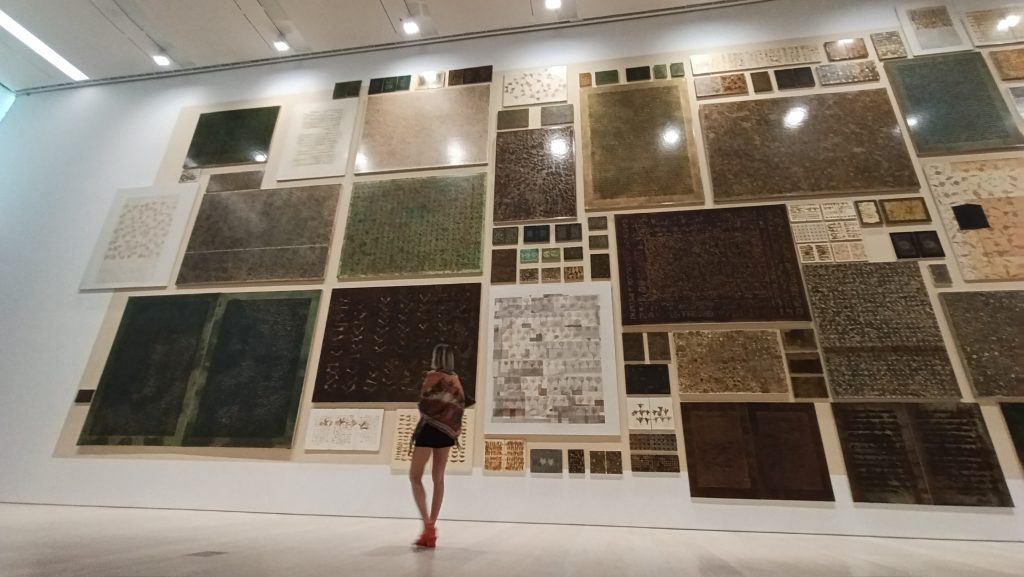
Berkmen: There is also a challenge to the dominance of vision in that space. The same is true when you enter the large wall installation in the dark. It doesn’t reveal itself all at once. Perhaps you can’t even see it in its entirety. By becoming quieter and calmer, you step away from the experience of being overwhelmed or controlled by what you are looking at.
Erdoğmuş: It is really a journey—from light into darkness, and then back again from darkness into light. Like day and night, like time itself. In many ways, it is life. It invites another way of seeing. In that dim light, people may not notice every detail, and that is exactly what we wanted: for a process of discovery to emerge. We wanted visitors to use their phones as light sources, to let the sounds beside them guide them somewhere else, to venture further into the space. Just as you would explore a real cave, we wanted people to remain open to investigation—to look from afar, to observe closely, and to enter into an intimate relationship with what they encounter. To look through a microscope, through a telescope, through touch. To try to read a text that isn’t there, to discover something because of a sound. That room is a machine for generating worlds. That’s how it works.
Berkmen: Your notion of “alienation” resonated with me deeply. It’s only when we step back from something that we begin to observe it with greater care. We stop taking the familiar for granted. Darkness is one of the ways this becomes possible. It invites us to look more attentively and, through that attention, to move into a closer relationship with what we see.
Perhaps the real challenge is to first strip away the self. Would you agree?
Erdoğmuş: Yes, you free yourself from your preconceptions. You leave behind your ideas about what painting should be and what art should be. Instead, you try to understand what is actually there. You lose sight due to darkness. And then, you start seeing in the dark. Somewhere in the midst of it, there is a sound… That “chorus” tells you something each time. You begin to pick something out of that “noise,”. That is where the journey truly begins.
The important thing is how you respond when we take you from light into darkness. You may decide you’ve had enough and leave, or you may become curious enough to continue. In the end, the experience gives back whatever you ask of it. That was the idea I wanted to pursue. It was never about dictating a single interpretation.
Berkmen: Curiosity is really at the heart of all this. Tayfun mentioned that, as a child, he used to take his toys apart just to see how they worked, and then try to put them back together. There has always been this profound curiosity about the mechanisms of life—a desire to look as closely as possible at how things come into being. It’s something that has remained a constant throughout his practice. I think what we’re also trying to do is create the conditions for that same kind of world to open up for the viewer.
Given that the exhibition engages so deeply with questions of perception and experience, what are your thoughts on the design and content of the accompanying exhibition catalogue?
Berkmen: Umut Altıntaş will design the exhibition catalogue. From what we’ve seen so far, we believe it will be outstanding. Having spent considerable time in Tayfun’s studio, he has a profound understanding of both the works themselves and Tayfun’s layered approach to making and thinking. He has already developed graphic concepts that respond to those qualities. Alongside my own essay, the catalogue will include a previously published text by Murathan Mungan, an essay by Bejan Matur, and a contribution from the German art historian Stephan Körner.
Erdoğmuş: I’m talking about Prince Pückler’s Palace in Cottbus. Prince Pückler lived in Egypt during the eighteenth century and spent roughly six months in Istanbul, giving him a close knowledge of Eastern culture. When he returned to his family estate, he transformed it using what he had learned about water systems, constructing canals and even pyramids. He was known for his refined lifestyle, his distinguished hospitality, and his appreciation of food. The estate also contains the family’s libraries and collections of arms. I once presented an exhibition there.
That exhibition was installed in the library, where works I made between 2006 and 2012 were shown alongside pages from the library’s books. Since my own works often resemble pages, the exhibition established a visual and conceptual dialogue between them.
He is now writing an essay that reconnects those two worlds. It examines my engagement with landscape, nature, and environmental questions—topics that are especially urgent in Germany today, as groundwater levels continue to fall. The estate even has its own Tree University, which makes that connection particularly compelling. Given that I myself have had a relationship with Germany spanning almost forty years, we felt it would be valuable to include his perspective in this exhibition as well.
Berkmen: And there’s also a remarkable contribution by Yağız Özgen, who was both Tayfun’s student and, for a time, his assistant. His essay examines Tayfun’s studio practice through the lens of art theory, while also offering the insight of someone who participated directly in that process.
To conclude, I’d like to return to the themes of mortality and immortality as they appear throughout the exhibition and your artistic practice. Where, in your view, do optimism and pessimism reside within that landscape?
Erdoğmuş: I don’t know if I have a definitive answer to that. But we can perhaps speak of life as something that begins with the transmission of information. The neurosurgeon Türker Kılıç writes about these very questions. He describes life and vitality in terms of the continuous transfer of information. The body is in a constant state of change, yet memory remains. That is also how I think about knowledge: it is what is passed on, what continues, and what sustains our living existence. Nothing truly vanishes. It may simply become the material from which another form of life is made.
Berkmen: I think that depends very much on the frame of mind of the person encountering the work. For a long time, I was seeing what I would call “plant remains”—layered traces of things that belonged to the past. That was especially true when I looked at the works one by one, as digital reproductions on a computer screen. But once the large wall installation took shape in the exhibition, something shifted. What emerged instead was transformation, vitality, multiplicity, and diversity. Entirely different forms of life began to come to the surface. So, I think the exhibition ultimately holds both possibilities at once.
Someone might say, “I’d rather remember only the things I choose to remember than the things others remind me of.” Is there anything wrong with that?
Erdoğmuş: No, not at all. I actually believe that’s exactly how it should be. A person doesn’t need to be open to everything—only to the things they genuinely want to receive. If something does you good, you should be able to take it in.
In other words, is a person’s history defined only by what they remember?
Tayfun Erdoğmuş: Absolutely. That’s very much what those early notebooks were about. They were made up of the things I chose to keep—the memories I sifted through and held on to. They drew on what I remembered from my childhood and my early youth. I’m sure I experienced countless other things, but they never came back to me, and I never called them back.
Info: arter.org.tr