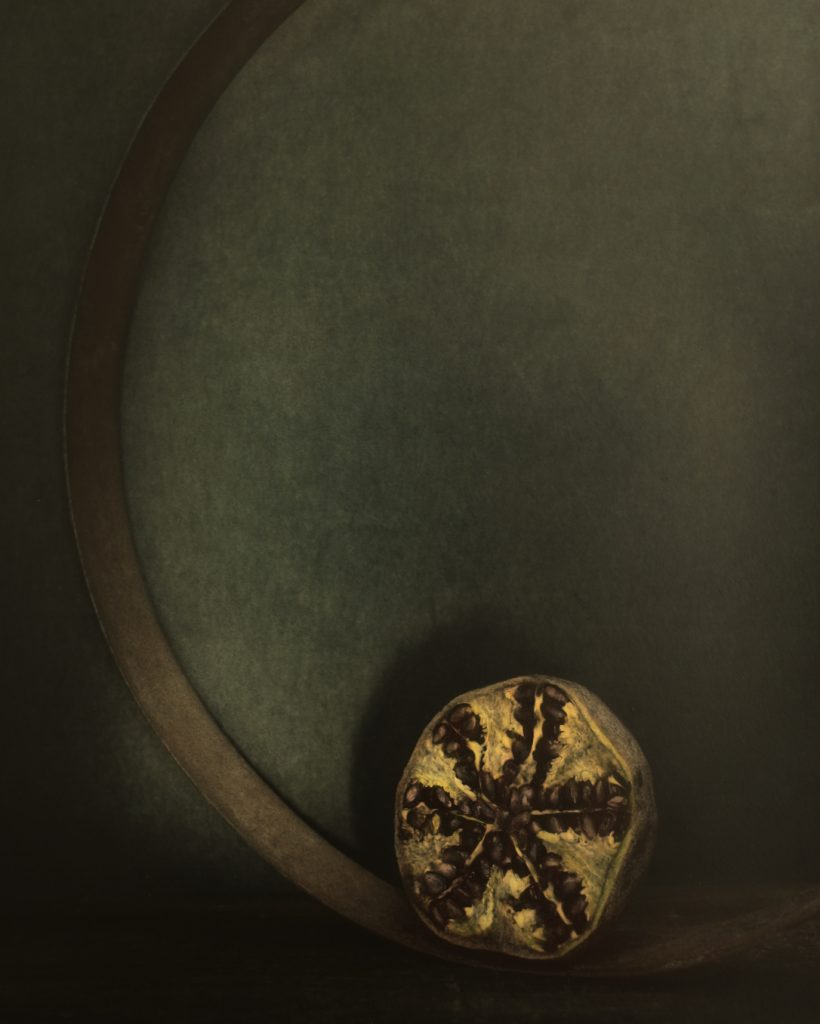
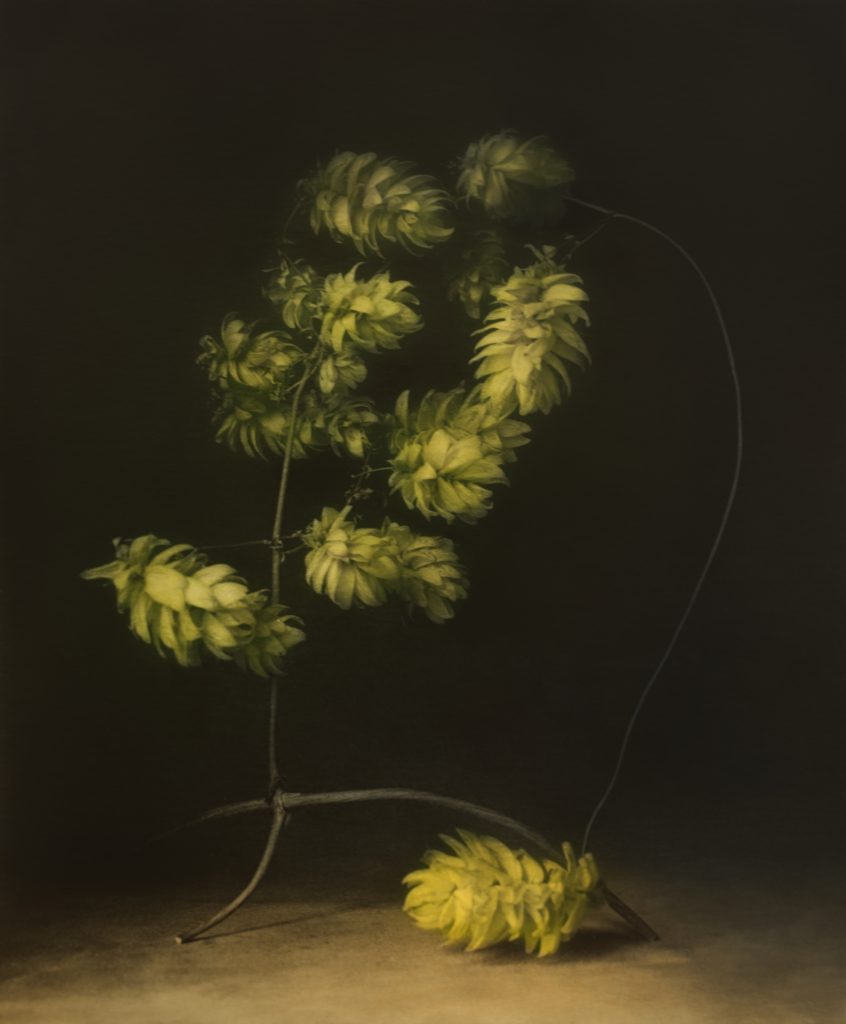
Having begun his artistic career as a self-taught artist, German contemporary artist Ingar Krauss—whose works have been acquired by the collections of Sir Elton John and Hermès Paris—presents The Quiet Radiance of Things (Das Licht der Stillen Dinge: La Paisible Lueur des Choses) at Camera Obscura Paris through June 7. In these works, where Krauss explores the transcendent expressive potential of still life within carefully constructed boxes, he offers one of the most romantic, melancholic, and philosophical tributes imaginable to the love affair between photography and painting.

The Gardener Who Brought Canvas and Shutter Together / Evrim Altuğ
At the end of May, I had the chance to visit yet another exhibition in Paris, this time at Galerie Camera Obscura, located at 268 Boulevard Raspail.
The exhibition belonged to German contemporary photographer Ingar Krauss (b. 1965), whose images filled the dimly lit gallery with a quiet confidence. It was the kind of exhibition where I felt I could drink in, like a glass of white wine, the weary yet assured silence of light itself.
As its title suggests, this melancholic, dramatic, and genuinely heartfelt exhibition invites visitors to experience The Quiet Radiance of Things and will remain open until June 7.
Born in East Berlin, Krauss directs his lens toward the authentic, approaching it with a deeply personal sincerity in an effort to reclaim the true nature of still life.
In Krauss’s exhibition, shaped by the maturity and richness of a disciplined eye, living and inanimate subjects share the half-light of noble frames in quiet fidelity to one another.
In these photographs, which seem to have sworn an oath to become paintings, Krauss’s compositions—crafted with almost encyclopedic diligence—test the viewer’s patience and sincerity of looking.
The more one looks at the artist’s works—whether from afar or up close—the more elements of hyperrealism, photorealism, and a fondness for Gothic palettes merge with what is seen in the gallery, opening onto a distinctly existential vastness.
Known for his black-and-white portraits of both people and objects, Ingar Krauss uses the dreamlike clarity of his images to pursue the very essence of existence.
In these small worlds that the photographer observes and generously offers to us, a sense of continuity and familiarity gradually takes hold—much like a glass of wine so pleasing that it seems to invite you to have another.
Each composition within its frame becomes, in the limited autonomy of its allotted space, a small room in the transient hotel we call life. Krauss seems well aware of this. Like a greengrocer of existence, he displays his compositions in clearly defined boxes, presenting them for contemplation. At this point, Galerie Camera Obscura offers us the following companionship:
“For Krauss’s compositions, the notion of containing their ‘characters’ within a box emerged as an instinctive and obvious choice. This approach enabled him to work exclusively with natural light, dispensing with studio arrangements and lighting equipment, while establishing an atmosphere that is timeless, sincere, and protected.”
The light that emerges recalls classical painting, where the soft dimness of north-facing studios was used to capture the physical reality of objects and, more importantly, their spiritual presence.
Yet, unlike the classical tradition, there is no symbolic code in Krauss’s works that demands interpretation. There is only the existence of objects and their quiet glow. Even so, that very existence, held in suspension across time, indirectly suggests loss and transience. In this sense, the works carry what might be described as the memento mori of all still life: a reminder that all things are mortal.
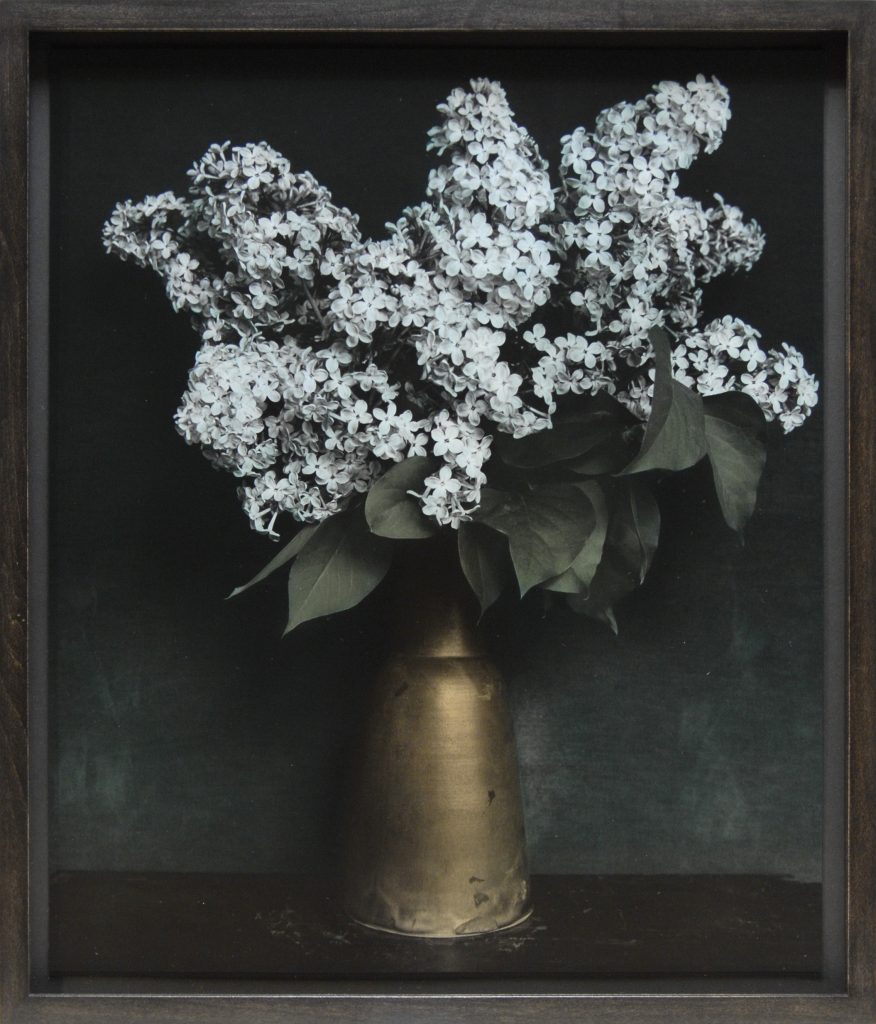
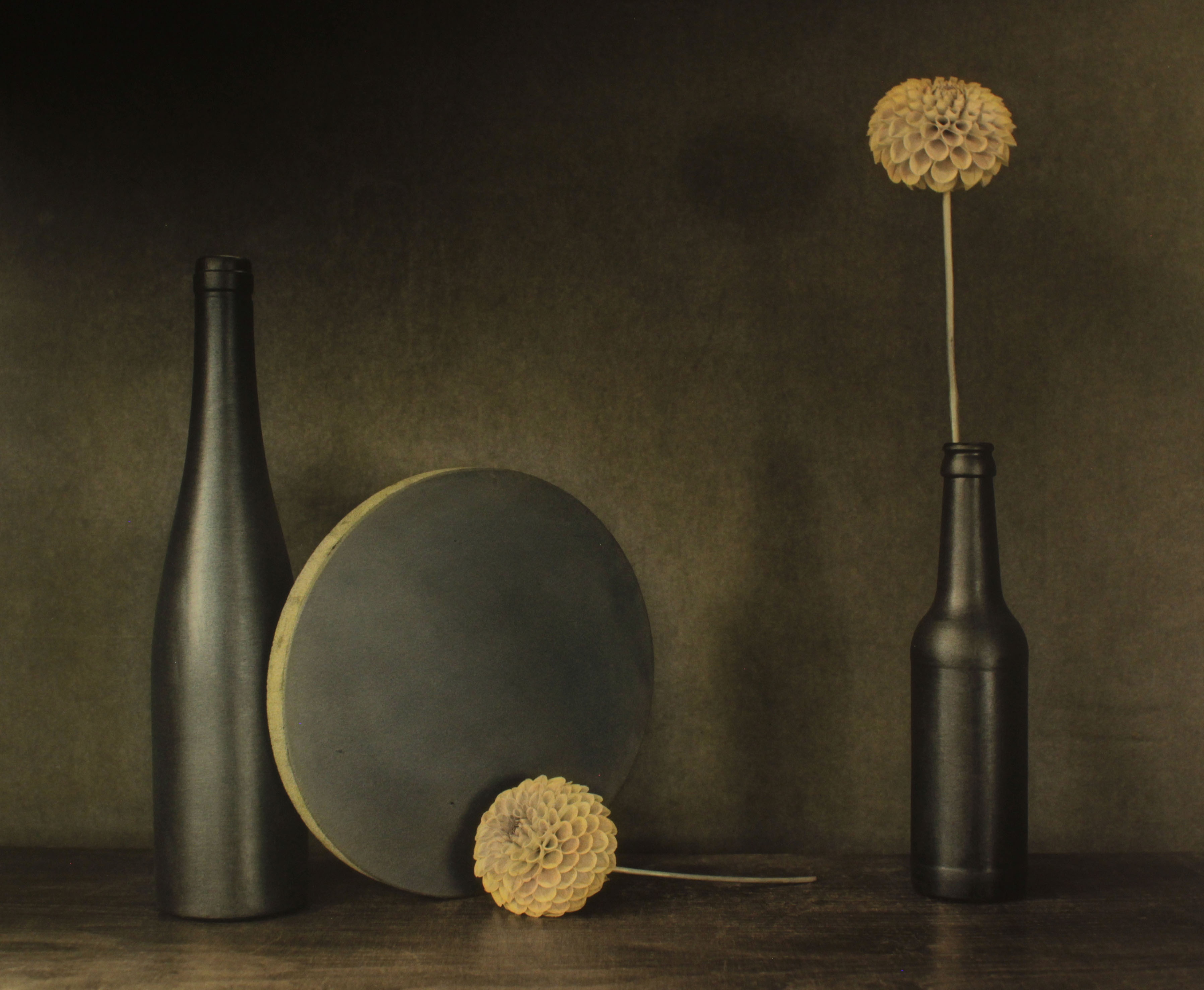
Take Krauss’s Pale Yellow Elderflower Bouquet (2024), for example. In the artist’s distinctive half-light, a fallen flower stem rests beside a black vase filled with pale yellow elderflowers. The flower on the ground seems increasingly distant from those still standing in the vase, gently suggesting the quiet progression of fading and disappearance.
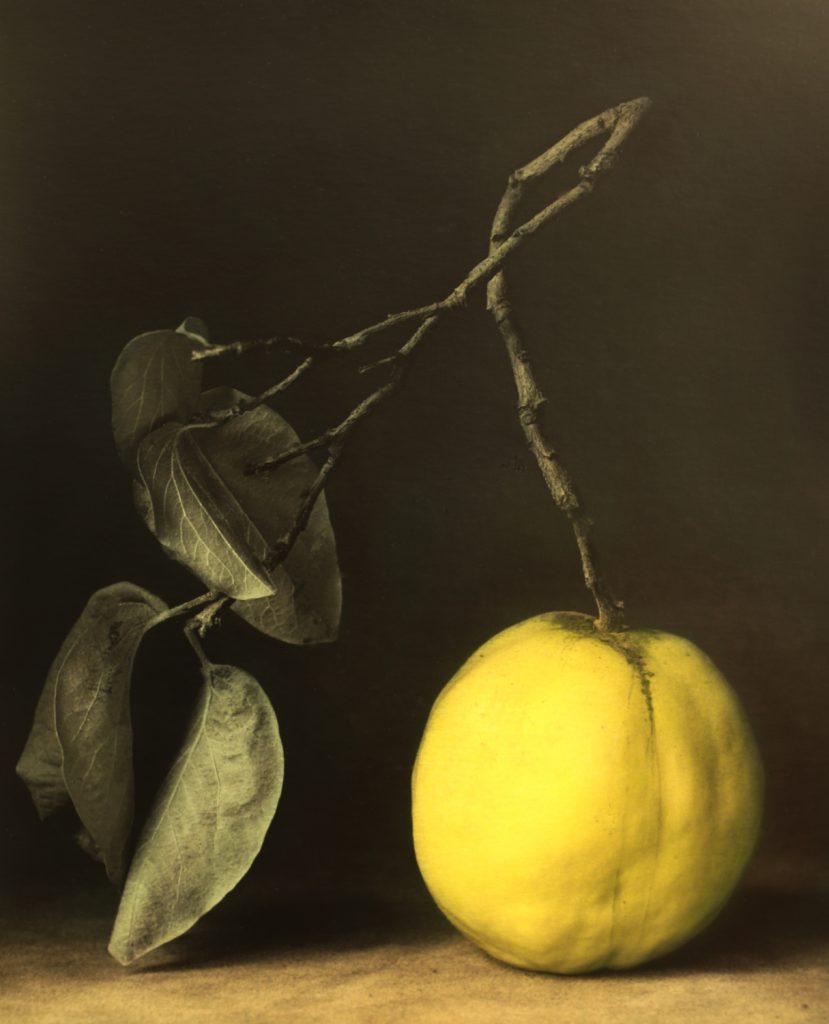
Or take Quitte (2024), where Krauss presents a vibrant yet tart-yellow quince still attached to its dry branch. Here, the visual narrative grows even more profound. With its unsettling, oversized, and twisted leaves, the quince almost seems to deserve a capital letter. The leaves become a kind of ledger of the Quince’s doubts, silently surrounding and defining its presence.
Ingar Krauss’s artistic journey began with the paintings he created while earning a living as a night watchman at a psychiatric hospital. From there, he moved into photography, gradually emerging as the creator of a distinctive visual language that would gain international recognition.
Having received grants from institutions including the Berlin Senate Department for Culture, the Robert Bosch Foundation, the Brandenburg Ministry of Culture, and Künstlerhaus Schloss Wiepersdorf, Krauss first established himself in Germany, then in Italy, before becoming one of the most sought-after names across Europe and the United States.
A frequent participant in international artist residency programs, Krauss’s portfolio also includes another photo-painting depicting Two Tomatoes in Bottles. In works that consistently remain around 40 x 50 cm in scale, Krauss records the tensions between presence, light, shadow, and power—both within things and in their outward existence—with a gaze that is at once deeply romantic and remarkably restrained.
To explore the source of the empathy, visual discipline, and remarkable patience present in Krauss’s practice, it is worth turning to the following illuminating biographical information, kindly shared by gallery representative César Champetier:
“Krauss is not only a photographer; he is also a beekeeper who tends a garden where he grows flowers and vegetables. This practice is as important to him as the creation of images and, in many ways, represents the ideal metaphor for his work. Just as a gardener attempts to shape and order nature, the artist constructs an image of the world through his creations.”
The gallery follows this reflection with a quotation from Hugo von Hofmannsthal, the versatile Austrian author, poet, librettist, and narrator, known not only for his literary range but also for having published works under a number of pseudonyms:
“The gardener does with bushes and plants what the poet does with language; he arranges them so that they seem new and unfamiliar, yet at the same moment become wholly themselves, as though they had only just come into being.”
While presenting Krauss’s works, Galerie Camera Obscura once more embraces the role of a companion to the viewer, accompanying the exhibition with the following words:
“His admiration for portrait painting—through which his work first gained recognition—eventually led Krauss toward still life. It became a focus that occupied him almost entirely for years.
The prominence of these two important artistic traditions within Ingar Krauss’s oeuvre is far from accidental. Krauss has long expressed a deep admiration for Balthus as well as for the still-life paintings of Juan Sánchez Cotán (1560–1627).
“Portraiture and still life share a common exploration of the world—one that sets aside haste and movement in favor of stillness and contemplation. This photograph reflects that very character: focused, like a peasant or a craftsman, directly engaged with things themselves.”
In this context, another “double portrait” stands out within Krauss’s body of work: two young eggplants which, although detached from their stems, seem almost to be flirting with one another through their posture and gesture-like body language.
The artist organizes the vegetables, fruits, and plants he portrays, together with their stems and branches, with such refined visual judgment that they cease to function merely as still life and instead become solemn record-keepers of the mortality that resides within human nature itself.
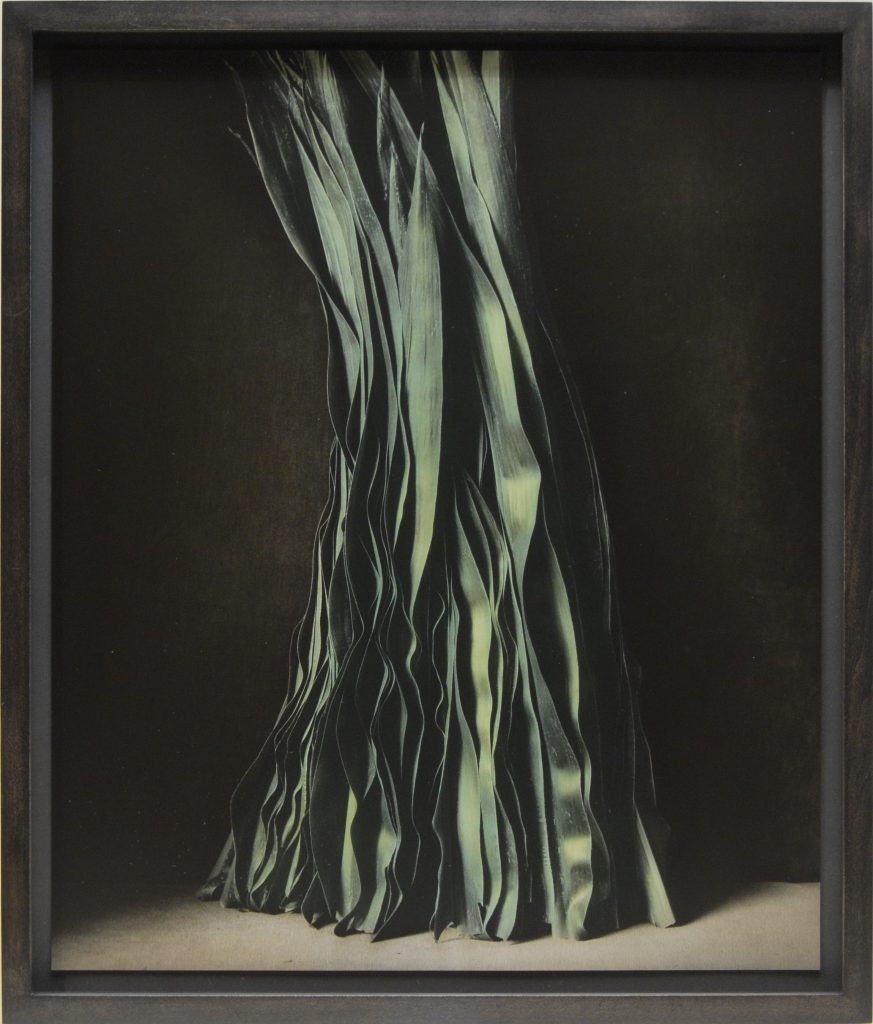
Speaking of mortality, Krauss does not abandon irony. Elsewhere in the exhibition, he presents hop vines—the plant used in beer production—with the same sympathetic graphic vitality. Along the sensory path traced by this work, life continues to play hide-and-seek with the viewer’s gaze, quietly asserting the privacy of its own existence.
But where, exactly, do the magic, the mystery, and the craftsmanship of these works reside?
According to information provided by the gallery, and if we are to offer a more technical description, Krauss works in the traditional manner of medium- and large-format analogue photography. He produces his own prints by enlarging his photographs onto black-and-white silver gelatin paper, which he subsequently hand-colors with oil paint.
This method requires a layer of oil paint to be applied to moistened paper, so that the color permeates the gelatin emulsion while leaving the surface of the photographic paper unaffected.
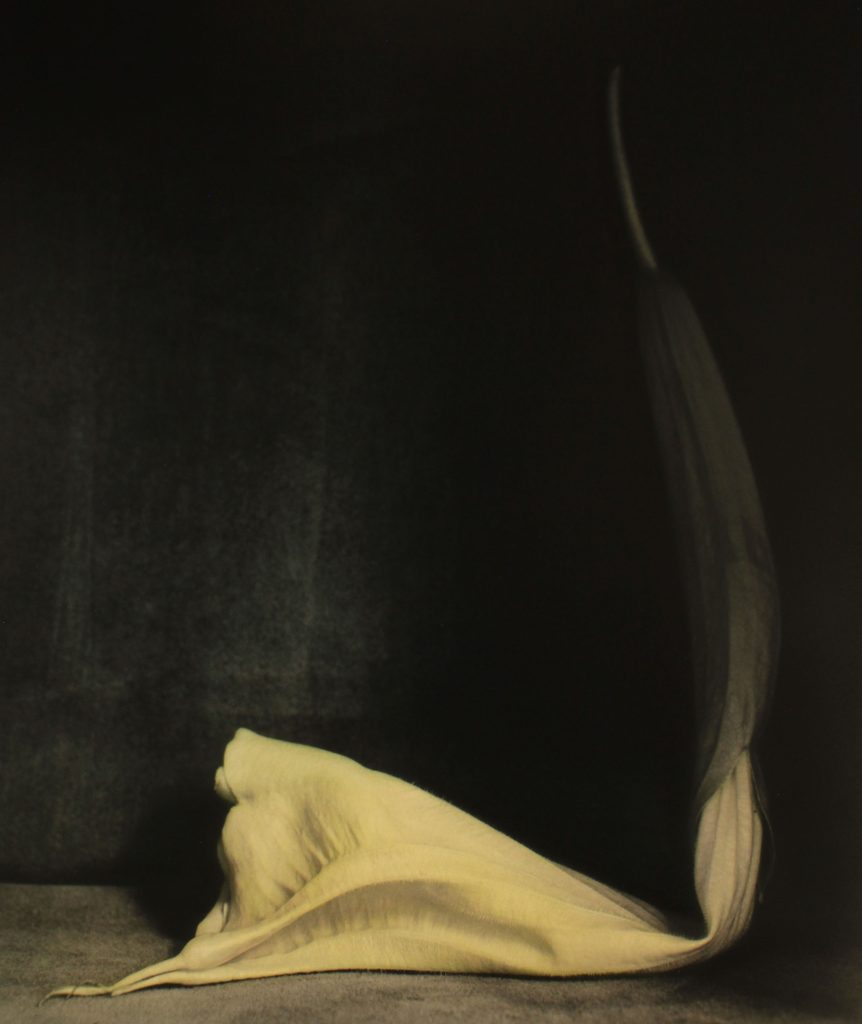
Krauss, whose works are included in the collections of Hermès Paris and Sir Elton John, held his first exhibition in 2002 and has since built a career that includes around twenty solo shows. Also a familiar presence in many collective exhibitions, the artist presents visitors to Camera Obscura Paris with works such as Lily (2015), Bauerngarten (2021), and Sugar Beet (2017–2019), while simultaneously exploring territories of near-total graphic abstraction and monochrome imagery.
Rather than attempting to say more about these gentle, meticulous, and quietly reserved works—through which Ingar Krauss reconciles idea with object, standing almost as a witness to the marriage between painting and photography—it may be best simply to keep looking at them until darkness fully descends, until they have told us everything themselves, leaving the lights of every possible dream softly illuminated.
For Information: galeriecameraobscura.fr