


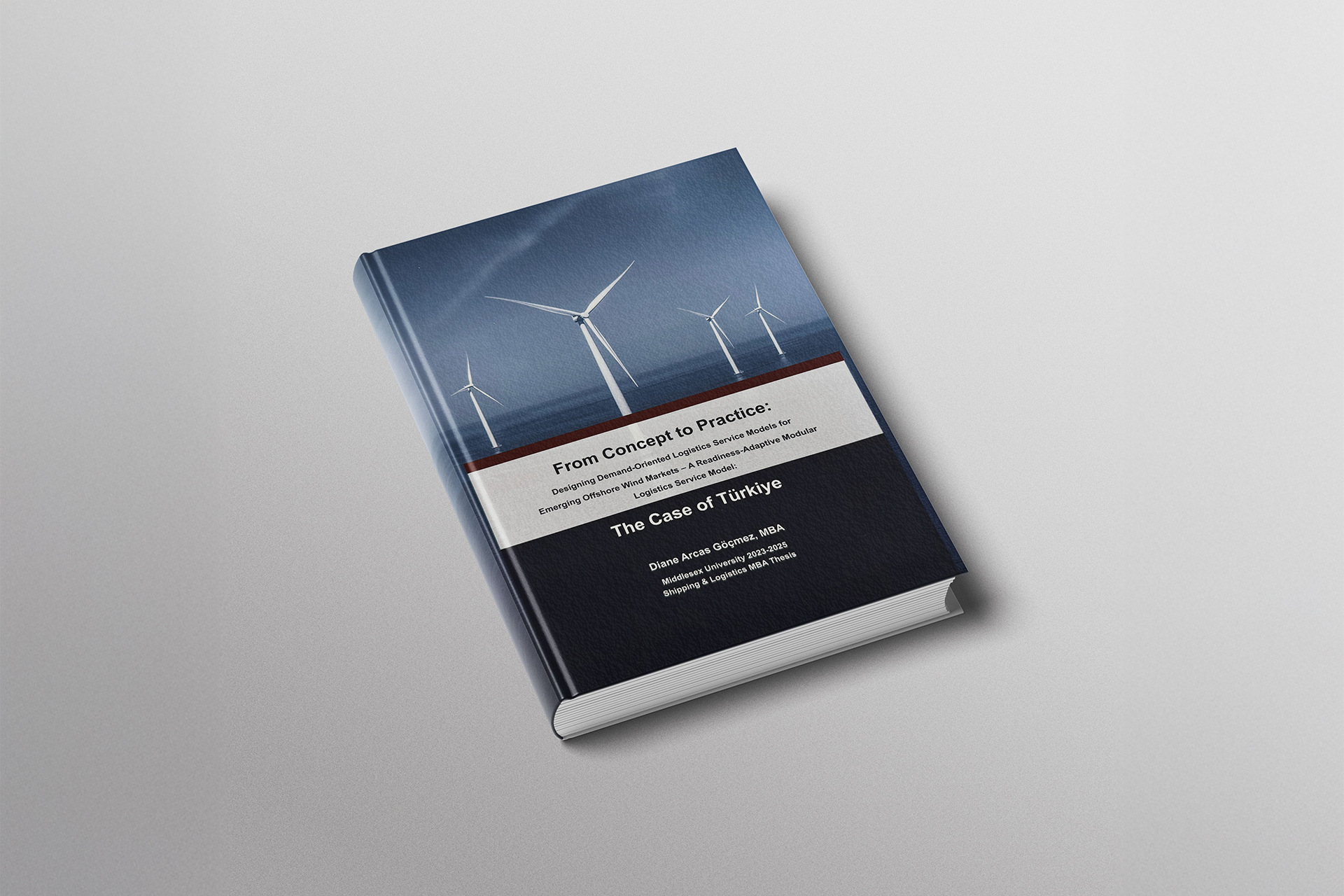
The first academic study to comprehensively address the logistics dimension of offshore wind energy in Türkiye was written by Arkas Holding Vice President Diane Arcas Göçmez as part of the Middlesex University MBA program. The thesis presents a holistic logistics perspective on an offshore wind ecosystem that can be built upon Türkiye’s strong industrial foundation.
The MBA thesis titled “From Concept to Practice: Designing Demand-Oriented Logistics Service Models for Emerging Offshore Wind Markets – The Case of Türkiye” examines Türkiye’s offshore wind ecosystem from a systematic logistics perspective. The country’s advanced manufacturing capabilities, strong wind energy expertise, and strategic location constitute the foundation of the study. Building on this theoretical framework, the thesis represents the first comprehensive academic analysis to address the emerging offshore wind sector from a logistics perspective and to develop a modular logistics service model.
The Motivation Behind the Study
Diane Arcas Göçmez explains her motivation for the study as follows:
“My motivation for this project arises from Türkiye ranking fifth in onshore wind production in Europe and possessing an estimated offshore wind potential of around 75 GW at a time when national energy demand is expected to increase by 67% by 2035. Through Arkas Logistics’ involvement in onshore wind logistics projects, I had the opportunity to observe first-hand the operational dynamics of renewable energy supply chains and the structural gaps within the sector.
This project reflects my commitment to contributing scalable and structured logistics solutions to support Türkiye’s emerging offshore wind ecosystem.”
Where Academic Rigor Meets Industry Experience,
Diane Arcas Göçmez’s thesis demonstrates a structure that brings together academic methodology and hands-on operational experience. The practical expertise gained from Arkas Logistics’ onshore wind projects strengthens the applied dimension of the research, while the academic approach provides the depth and consistency required for international benchmarking.
This combination positions the thesis as a valuable reference source for the business community, public institutions, and academia alike.
A Strong Manufacturing Base Supporting the Offshore Ecosystem
The thesis examines the installation phase—one of the most critical stages of offshore wind projects—in detail from a logistics perspective. Türkiye’s advanced manufacturing capacity in wind energy components, its long-standing shipbuilding tradition, and the proximity of certain ports to production hubs together create a strong foundation in this field.
Moreover, the multi-layered operational structure that characterizes offshore projects brings with it a broad need for coordination, from transportation to installation planning. The study addresses this structure as an evolutionary process aligned with Türkiye’s expanding energy vision.
A Roadmap in Line with Global Standards
The thesis analyzes the criteria that project developers, original equipment manufacturers, utility companies, and engineering, procurement, construction, and installation (EPCI) contractors expect from logistics in global projects. In this context, key focus areas include logistics input during the design and front-end engineering phases, load optimization, heavy-lift operations, digital planning infrastructure, and end-to-end coordination.
The study presents, in a measured tone, that Türkiye’s existing capabilities hold the potential to meet these expectations and that, within the sector’s natural course of development, such competencies are likely to gain increasing importance.
A Strategic Approach Steering the Industry
Arcas Göçmez’s study highlights the strategic role of logistics in Türkiye’s offshore wind journey, a key component of the country’s evolving energy vision. The thesis offers a strong conceptual framework on how the multi-layered structure—ranging from ports and production lines to supply chains, operational planning, and digitalization—can be managed in an integrated manner.
This framework contributes to advancing sectoral initiatives in a more coordinated, data-driven way, aligned with international practices.
A Guiding Study for the Energy Transition
The sustainable success of offshore wind investments, which play a critical role in Türkiye’s energy transition, requires the integration of logistics with strategic planning. This study systematically outlines the institutional coordination and integration framework that must be built upon the country’s existing industrial capacity.
Arcas Göçmez’s study provides an analytical foundation for Türkiye’s progress in this field, offering a contribution that addresses both present needs and future development.