


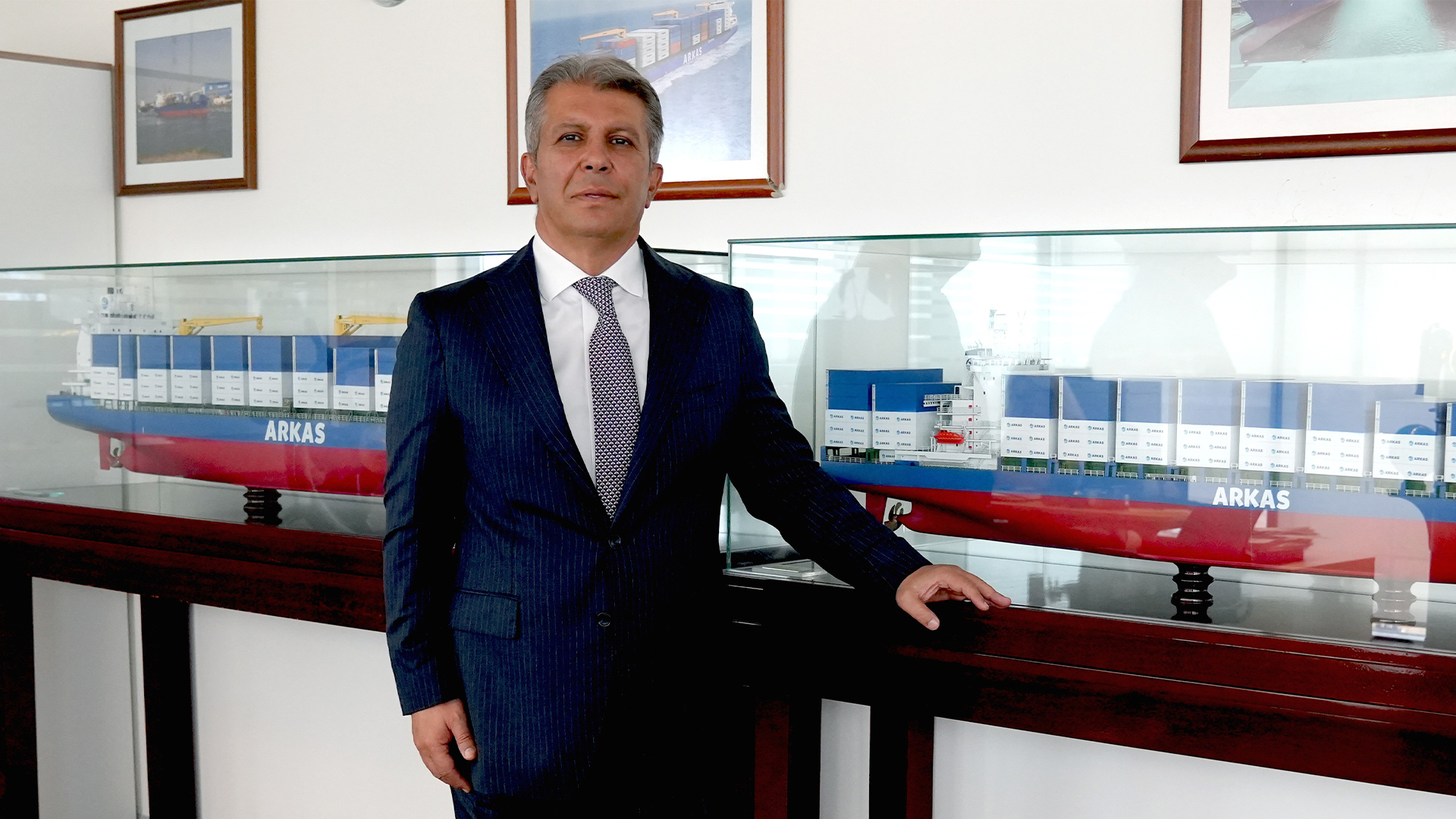
Haluk İribaş, CEO of Arkas Maritime Fleet, said that Arkas’s success in international inspections is significant not only for the company itself, but also for the international visibility of Türkiye’s maritime industry. Arkas Maritime Fleet ranked third worldwide in the international Port State Control assessment and first globally in the large container vessel category. This achievement is underpinned by the expertise of Turkish seafarers, the discipline of Arkas teams, a strong corporate culture, continuous training and an effective inspection system.
What does Arkas’s ranking third worldwide in the international Port State Control assessment and first globally in the large container vessel category mean for Türkiye and the maritime industry?
Ranking at this level among companies assessed worldwide is extremely valuable to us. What makes this result even more meaningful, however, is that it was achieved by a Turkish company through the efforts of Turkish seafarers.
Arkas’s strong performance in this ranking, achieved with its Turkish crews, demonstrates the high level of expertise, technical competence and professional discipline attained by Turkish seafarers internationally.
We do not regard our performance in international inspections solely as a success for our company. We believe this result also contributes to the credibility of the Turkish flag and to the international visibility of Türkiye’s maritime industry.
How would you describe the role of Turkish seafarers and the shipboard and shore-based teams in this achievement?
At the heart of this achievement are our teams working both on board and ashore. Standards, procedures and inspection systems are extremely important in shipping; however, it is the people working toward the same goal who turn these structures into successful results in practice.
The expertise, sense of responsibility and professional discipline of the seafarers serving on our vessels are directly reflected in the results we achieve in international inspections. Our shore-based teams also support this performance by closely monitoring operations, maintaining continuous contact with the vessels and accurately assessing the needs arising from the field.
At Arkas, our colleagues do not see their work as being limited solely to their own areas of responsibility. Each of them acts with the awareness that they represent Arkas internationally. The company’s people-oriented approach also strengthens the sense of belonging, trust and responsibility within our teams.
The results we have achieved today are the outcome of the collaborative working culture shared by our shipboard and shore-based teams.
How are the corporate culture, training and human resources approach that make this result possible shaped?
Behind this success are a strong corporate culture, a disciplined approach to work and long-term investment in human resources. Shipping is an industry where even the smallest detail can have major consequences. For this reason, discipline, close follow-up and responsibility are fundamental parts of our daily working culture.
We take a long-term approach to talent development. A significant proportion of our officers join us from their cadetship period onwards, and we support them through comprehensive training programmes. Training does not end when they reach the rank of master or chief engineer; it continues at every stage of their careers.
This approach is not limited to the transfer of technical knowledge. The fact that our colleagues develop within the same working culture creates a shared operational standard. This standard is directly reflected in our inspection performance, safety culture and day-to-day operations.
For the past two years, we have also been implementing psychological assessment processes. We identify areas in which our colleagues have room for development and provide them with the support they need. In this way, we complement technical competence with a development system that takes a holistic approach to the individual.
What kind of system is required to sustain high performance across more than 270 international inspections?
Achieving high performance across 273 international inspections is not a result that can be attained solely through preparations made during inspection periods. We do not view an inspection as a separate preparation process that begins only as the inspection date approaches. Our vessels operate in compliance with these standards every day of the year.
We support this with a robust internal audit system. At frequent intervals, we conduct comprehensive assessments covering both deck and engine departments. We have an experienced audit team within our organisation that has an in-depth understanding of our vessels and operations.
We examine every incident encountered during inspections or day-to-day operations in detail and investigate its root cause. We do not simply record the findings; we identify the necessary actions and incorporate them into the relevant areas, from maintenance processes to operational practices.
With this approach, every case also becomes a learning opportunity for us. We continuously improve the system to prevent similar situations from recurring. This demonstrates that our high performance is not a matter of chance, but the result of a sustainable operating model.
What made you most proud about ranking among the top three in an assessment of hundreds of companies worldwide?
What makes us most proud is that this result reflects many years of disciplined work.
Maintaining a consistent standard in our day-to-day operations is already a fundamental part of our work. However, achieving a top-three position in a ranking that assesses hundreds of companies worldwide demonstrates how firmly our teams are focused on the same goal.
For me, the most valuable aspect is that this achievement is not merely a ranking result, but an international reflection of the working culture firmly established at Arkas.
What role will the USD 660 million investment in 12 new vessels play in the future of the fleet?
By 2028, we will add a total of 12 new vessels to our fleet: six with a capacity of 4,300 TEU and six with a capacity of 3,100 TEU. With this investment, we aim to make our fleet more modern and efficient, with stronger environmental performance.
The new vessels will also bring modern designs and next-generation engines into the fleet. We believe this will deliver significant benefits in terms of safety, operational efficiency and environmental performance.
Our existing fleet already undergoes highly rigorous processes from both commercial and technical perspectives. As part of our cooperation with global companies such as Maersk and Hapag-Lloyd, our vessels are regularly assessed and receive high scores in these inspections. Our vessels operating on the America service are also subject to comprehensive inspections.
We expect this new investment to reinforce the operational reliability we have achieved today with a stronger fleet infrastructure and to further enhance our inspection performance. As our fleet grows, maintaining the same standards of quality, safety and discipline remains among our priorities.
How will the maritime industry transform in the coming years, and how is Arkas preparing for this transition?
The transformation driven by environmental and sustainability priorities will accelerate further in the coming period. Reducing carbon emissions, improving fuel efficiency, using alternative fuels and complying with new regulations will be among the industry’s key priorities.
We are also carrying out initiatives across our existing fleet as part of this transition. We have completed propeller retrofits on our vessels, installed scrubber systems and implemented measures to improve coating conditions. With the addition of the new vessels to the fleet, more modern designs and next-generation engines will further support this transformation.
Biofuel is also one of the key areas of this transition. The work carried out by Arkas Bunker as Türkiye’s first ISCC-certified biofuel supplier provides us with valuable experience in this field. Solutions such as BioF30, which can be used without requiring any modifications to a vessel’s existing fuel system and help reduce carbon emissions, represent an important step in the transition to lower-carbon fuels.
Our sustainability efforts are therefore not limited to investments in new vessels. We address different areas together, from technical applications across our existing fleet to fuel supply.
What is the next goal for Arkas Maritime Fleet following this achievement?
First and foremost, we want to maintain the level we have reached and make it sustainable. Our operations will expand as the new vessels join the fleet. Managing this growth while maintaining the quality, safety and operational discipline we have today is one of our key priorities.
For this reason, we will continue to invest in our people. In addition to supporting the technical development of our teams, we will also strengthen their psychological resilience. Because as our fleet grows, sustaining the same level of performance depends not only on our systems, but also on the strength of our people.
Our next goal is to maintain this performance as our fleet grows and to further strengthen Arkas’s reliability and reputation in the international maritime industry.